

b2ap3_thumbnail_cloud_uses_400.jpg

4 Ways Cloud Computing Can Benefit Any Business

b2ap3_thumbnail_cloud_uses_400.jpgIs your business using the cloud in 2016? If not, you should know that it’s a great tool that’s designed to help your business better manage its data and application deployment. However, the cloud can be used for so much more, and it’s quickly becoming an indispensible tool for SMBs.

Here are four ways that cloud computing is changing the way that small businesses handle their technology.

Data Storage
The cloud is a great way to share data amongst your entire organization, and deploy it on a per user basis. Businesses can store their information in a secure, off-site location, and the cloud allows them to access it through an Internet connection. This eliminates the need to host your data internally, and allows your employees to access information from any approved device through a secure connection, effectively allowing for enhanced productivity when out of the office.

Application Deployment
Your business relies on having various types of applications and software solutions available for use. If you lose access to these programs, you could be facing lost productivity and downtime, which could directly influence your bottom line. If you’re using the cloud to deploy your applications, any Internet-connected device can access the applications you need to keep work moving forward at a respectable pace. This opens up all sorts of opportunities for cost savings, including providing your team with the ability to work from anywhere.

Virtualization
The cloud can be an effective tool for virtualization, which is a great method for cutting costs for your business. By virtualizing physical IT components, you’re abstracting them for use in the cloud. This means that you’re storing them in the cloud. Businesses can virtualize servers, desktop infrastructures, and even entire networks for use in the cloud. Doing so eliminates the physical costs associated with operating equipment, allowing you to dodge unnecessary costs and limit the risk of hardware failure. For example, you can deploy all of your users’ desktops virtually from the cloud so you don’t need to rely heavily on more expensive workstation technology, and can instead use thin clients. Simply log into your company cloud and access all of your applications and data on virtually any Internet connected device.

Backup and Disaster Recovery
A BDR device relies on the cloud to ensure quick and speedy recovery deployment. The BDR takes snapshots of your data, which are sent to both a secure, off-site data center, and the cloud. From there, you can access your data or set a recovery into motion. If you experience hardware failure, the BDR can temporarily take the place of your server, allowing you ample time to find a more permanent solution. The cloud is crucial to the success of a BDR device, simply because the cloud is where the BDR stores an archive of its data.

With so many great uses for the cloud, only one question remains: how will your business use the cloud in 2016? NuTech Services can help you get started. To find out more about your options, give us a call at 810.230.9455.


b2ap3_thumbnail_chromecast_stories_400.jpg

Tip of the Week: 4 Google Chromecast Features that May Surprise You

b2ap3_thumbnail_chromecast_stories_400.jpgGoogle is known for coming up with fun new technologies that change the way society consumes entertainment and performs their day-to-day responsibilities. One of Google’s best new gadgets is the Google Chromecast, which can change the way you view media and share content while both at home and in the office.

Google’s Chromecast is a neat device that allows you to turn your television into a smart TV. Chromecast uses your WiFi network to stream content from the Internet to your TV. You can then use a mobile device, or any laptop or desktop that’s connected to your WiFi, to control the Chromecast. A Chromecast can even be used in the office to add a sense of flair to any room with a TV, and to make collaboration easier for presentations and other media.

Without further ado, here are four great uses for your Chromecast device.

What a Chromecast Can Do

  • Stream music: If you’re hosting a get-together at your home, the Chromecast lets you stream music directly to your TV. Apps like Spotify now work seamlessly with Google Chromecast, making it a great way to lighten up any situation. Plus, some smooth jazz or soothing music might be just enough to calm your staff or impress a prospective client who wanders into your office.
  • Stream video: Whether you want to stream a simple YouTube video, watch television shows through Hulu or Netflix, or watch a movie, you can do so with Chromecast. There are plenty of entertainment apps that are ready to use through Chromecast, so it’s only a matter of finding one you want.
  • View pictures: If you want to liven up your TV when you’re not using it to stream media or content, you can have it display backdrops in between sessions. The Chromecast pulls images from all sorts of online libraries, including NASA, 500x, and several others.
  • Mirror your device’s browser: Whether you’re using your Chromecast for entertainment or work purposes, you can mirror your device’s screen to your TV. All you have to do is open your Chrome browser and use the Chromecast extension to cast the screen. This is particularly useful for sharing documents or presentations.

There are countless other uses for the Chromecast, but instead of spoiling everything about the device, we think it would be fun for you to find them out for yourself. With so much entertainment and content at your fingertips, you’ll be able to spice up both your home life and your office.

Bonus tip: One of our favorite Chromecast apps is VideoStream, an extremely simple app that lets you drag video files to your Chrome browser and play them on your Chromecast-connected TV.

Do you have a Chromecast? What’s your favorite use for it? Let us know in the comments, and subscribe to our blog for more great technology-related tips and tricks.

b2ap3_thumbnail_cloud_computing_lessons_400.jpg

3 Ways Businesses Can Get the Most Out of the Cloud in 2016

b2ap3_thumbnail_cloud_computing_lessons_400.jpgAs the cloud becomes widely adopted by SMBs the world over, companies have come to expect more from their cloud services. If you’re not taking full advantage of cloud computing, then you may be missing out on the many ways that it can help you meet your company’s goals.

According to Forrester Research, there are three goals in particular that the cloud can be leveraged for in order to enhance the operations of SMBs. Consider the following:

  • Decreased administrative burden: One of the biggest advantages of the cloud is its ability to outsource its required maintenance and management to someone outside of your company. Considering how stressed for time most managers are in SMBs, they will appreciate having yet one more responsibility taken off their plate. Think for a moment of all the other, more profitable things that your managers and IT team can do for your business if they’re not being bogged down by managing company files and software solutions.
  • Increased implementation speed: When a business chooses to implement a new solution, they want it ready to go as soon as possible. With the cloud, taking advantage of its many services is as easy as setting up an account for you and your team. Compare this to the effort it takes to install hardware and cables if you want to add a new solution to your in-house IT network.
  • Enhanced security, with minimal expense: Cloud security has improved vastly over the years, along with its affordability. When working with IT professionals like those at NuTech Services, you can protect your cloud offering with as little, or as much, security as you feel you need. This is yet another responsibility that the cloud removes from a manager’s plate.

The one thing that all of these benefits have in common is that they’re part of the public cloud computing option (which is different than the private and hybrid cloud options). While the hybrid and private cloud options have their own sets of benefits, the strength of the public cloud is that it provides organizations the most functionality, while only requiring a minimal amount of maintenance and oversight on behalf of you and your staff.

For the average SMB, the public cloud is the right fit, due to its ease of use. However, don’t let that discourage you from considering other cloud options. For example, a private cloud option is best for a business dealing with sensitive data, like health care records or credit card information. Additionally, the private cloud is good for businesses that have an adequate amount of capital on hand they can use to purchase in-house IT equipment.

At the end of the day, what it comes down to is going with a cloud solution that’s the right fit for your company. After talking with the IT professionals at NuTech Services, you may even decide that the hybrid cloud option is the right fit for your business (which combines the features of both the private and public cloud offerings). Whichever cloud computing option you go with, NuTech Services is here to help with its implementation and maintenance. To go with a cloud computing option that will be utilized to the fullest, give us a call 810.230.9455.

b2ap3_thumbnail_cloud_backup_and_security_400.jpg

Why the Cloud is the Best Option For Your Data’s Backup Policy

b2ap3_thumbnail_cloud_backup_and_security_400.jpgThe cloud is a great tool that can help your business fully leverage its technology solutions, but one of the most common problems that people associate with the cloud is that they believe it’s not nearly as secure as a private in-house IT network. However, contrary to popular belief, the cloud is a very secure medium for your data storage and deployment, particularly for your data backup needs.

For a demonstration, let’s take a common problem, like the storage of backed-up copies of data, and apply it to the cloud. There are two common ways to store data backups: on tape, which is prone to user error and requires a significant amount of physical space for effective use; and then there’s cloud-based backup. Normally, data backups would take up a ton of space on your in-house network. Furthermore, storing your data backups on the network that you’re backing up is just plain silly. Therefore, it makes the most sense to store your data off-site in a secure data center, or in the cloud.

The Shortcomings of Tape
Though tape backups have been used by businesses for a very long time, they’re an outdated technology that doesn’t appeal to the average small and medium-sized business. Tape can be considered a manual mode of data backup because it relies on human interaction to work properly. This means that it’s the responsibility of your staff to set the backup and make sure that it happens every night. Otherwise, you could potentially lose an entire day’s worth of work. Furthermore, processing a backup is a resource-intensive task that shouldn’t be done during normal work hours. In general, the tape backup process is inefficient and dated at best, especially in light of more modern backup solutions.

The Benefits of Cloud Backup
The benefits of a cloud backup solution are overwhelming when compared to the typical tape backup solution. While tape requires humans to set and perform backups, a cloud-based data backup solution automatically takes snapshots of data that’s been changed since the last backup was taken. This eliminates the chance of user error, and ensures that the backups are taken without a hitch. Unlike tape backups, which effectively take a backup of ALL data on the network, a cloud backup solution only tracks changes made to files. This means that there’s less strain placed on the system during the backup, meaning that data can be backed up multiple times without the severe repercussion of downtime.

The cloud makes storing data both more efficient and more secure, especially for backup and disaster recovery processes. NuTech Services’s backup and disaster recovery (BDR) solution is a device that’s capable of changing the way that your business handles data backups. With our BDR device, your organization can take advantage of multiple backups that are taken periodically throughout the day. Then, thanks to your data’s convenient location in the cloud, the BDR device can rapidly deploy the backed-up copy of your data to your business’s infrastructure. In the event of a hardware failure or similar disaster, the BDR can act as your server, allowing you time to find a more permanent solution to the problem.

For more information about our BDR device, give us a call at 810.230.9455.
b2ap3_thumbnail_implement_cloud_solutions_400.jpg

Study: The Cloud Can Double Small Business Profits

b2ap3_thumbnail_implement_cloud_solutions_400.jpgIf your business has put off embracing cloud computing as a legitimate method for data distribution and application deployment, it might be time to reconsider why you haven’t integrated a cloud solution yet. A recent study from software companies Exact and Pb7 Research shows that the cloud can provide your organization with a significant increase in both profits and net growth, proving once and for all that cloud business is better business.

Specifically, the study shows that the cloud can potentially double small business profits and help them achieve an additional 25 percent revenue growth compared to businesses that don’t take advantage of any cloud solutions. This study, which was published on August 19th, contains findings that are based on 750 interviews with small businesses, all of which have less than 50 employees. 51 percent of all respondents claimed to use at least one form of cloud computing software, while nearly 30 percent of small businesses in the United States admitted to using three or more cloud applications in the workplace.

In other words, most businesses are adapting to the cloud and using it to improve the way they operate. When asked why they chose to implement cloud solutions, businesses gave these top five reasons:

  1. Security: 32%
  2. Lower IT costs: 26%
  3. Low maintenance requirements, less physical infrastructure: 23%
  4. Easy mobile access: 23%
  5. More productivity and efficiency for end-users: 21%

Additionally, when asked to rate certain aspects of the cloud on a scale of 1 (low) through 5 (high), the average results were:

  1. Easy to use: 4.0
  2. Easier to find information: 4.0
  3. Easier to share information: 3.9
  4. Increased productivity: 3.9
  5. Easier to add and remove users: 3.8

While the reasons why cloud users implement the cloud vary, this proves that there are a number of benefits that this type of computing infrastructure can provide. When considering integrating a cloud solution for your business, you need to ensure that your organization can handle this change in protocol. Changing the way you deploy and manage your data and vital technology systems requires the attention of a knowledgeable professional. Contact NuTech Services at 810.230.9455 to learn more.

b2ap3_thumbnail_profits_from_the_cloud_400.jpg

Cloud Computing Grows at Staggering Rate While Traditional IT Hangs In There

b2ap3_thumbnail_profits_from_the_cloud_400.jpgIf your organization hasn’t considered the cloud as a viable business solution, stop what you’re doing and check some recent statistics. You might be surprised to learn that cloud spending is the third-biggest IT expenditure. Such popularity shows that businesses are finding the benefits that the cloud has to offer to be substantial, and you too can take advantage of the cloud to more effectively leverage today’s technology.

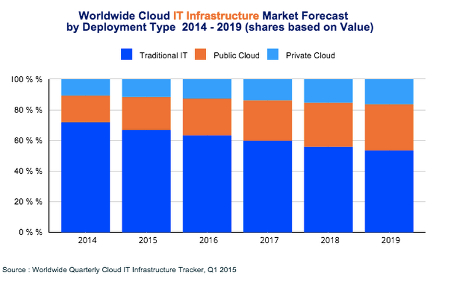
According to the Worldwide Cloud IT Infrastructure tracker for the first quarter of 2015, cloud IT will soon surpass even traditional IT models sometime in the next ten years.

value ib1

There are several noteworthy observations to make concerning this image:

  • Traditional IT is still the main player for 2015, rolling in at just over 65 percent of all deployments.
  • Public cloud IT accounts for around 20 percent of all deployments.
  • Private cloud IT makes up over 10 percent of all deployments.
  • Over the next five years, traditional IT will continue to decrease in usage, while the public cloud will make a significant jump in use. Private clouds will continue to grow, but not as quick of a rate as the public cloud.

On the financial scale, here are some statistics:

  • Spending on cloud IT infrastructures will reach $33.4 billion in 2015 alone.
  • Spending on private cloud infrastructures will grow to $11.7 billion.
  • Public cloud shows projected expenditures and growth of up to $21.7 billion.

As these numbers show, the cloud isn’t something that successful businesses should ignore. It’s not a gimmick or a fad. It’s a legitimate IT infrastructure solution that vastly improves operations and procedures. If you want to take advantage of the future of computing, cloud IT should be a top priority. The benefits greatly outweigh the cost in the long run, and there are a plethora of options to choose from; be it private cloud, public cloud, or even a mix of the two in a hybrid cloud solution.

The cloud has the ability to provide maximum mobility for your business, effectively allowing your employees to access critical systems that they might otherwise only be able to access in-house. This provides more opportunities for productivity, especially while on the road for a business trip or conference. Your team can choose how they want to work, and when, so long as the devices can access the Internet and are approved beforehand.

With the cloud dramatically changing the way we view the deployment of information and applications, we want to hear your thoughts about this revolutionary technology. Contact NuTech Services at 810.230.9455 for more information about how cloud computing can change the way your company works with technology.

b2ap3_thumbnail_cloud_backup_400.jpg

Introducing the 3-2-1 Formula to Effective Data Backup

b2ap3_thumbnail_cloud_backup_400.jpgWhile there are several options your business has for a backup solution, how much thought have you really put into it? As one of the most mission-critical functions of your IT infrastructure, you need to be sure that you’re getting the best solution for your money. More importantly, you need to know that you can rely on your solution to get you through the most trying times, like after a disaster or data theft.

Taking a 3-2-1 approach to your backup policy is a simple way to get comprehensive continuity for your data infrastructure. InfoWorld describes this concept as having three copies overall of your organization’s data, with two of these being in different formats, and one of them being stored off-site. This is difficult, if not impossible, to do with tape backup, which some businesses still run. However, there’s a much easier way to handle data backup in the form of cloud backup.

With cloud backup, your business can take advantage of safety and security that’s on the level of large enterprises. Unlike tape, which is limited due to the time necessary to perform a comprehensive backup, the cloud allows for multiple snapshots of your data taken throughout the workday. This gives you the peace of mind that your information is comprehensive and redundant. The cloud even makes recovery automatic and as easy as can be, making it ideal for both storage and recovery options.

There are two main issues of cloud data backup that most businesses get stuck on: the technical details, and the price of a complete infrastructure overhaul. Many small and medium-sized businesses feel that they can’t afford this solution, or they don’t have the manpower to ensure that all of the mission-critical technology is available. Being able to back up your files on demand is an essential part of today’s online business world, especially with hackers running amok. So, what’s a budget-minded SMB to do?

One solution is to call NuTech Services and let us explain our managed service offerings to you. Our solutions are designed to optimize operations and increase productivity on all fronts. In fact, our Backup and Disaster Recovery solution is one of our most important services, especially today when hacks can happen when you least expect them. It’s designed to take multiple backups of your data throughout the workday, and sending copies to both an off-site data storage, and in the cloud for easy access.

One of the best features of our BDR solution is its practical neutralization of costly downtime. When your server goes down due to a hack or other natural phenomenon, you’ll ordinarily lose access to any data stored on that server. However, a BDR device has the ability to immediately take the place of your server if it goes down for some reason, and it can deploy your backed-up data in a moment’s notice. This keeps your business running, even when your technology isn’t, giving you ample time to find an adequate replacement.

To make backup this easy, all you need to do is call 810.230.9455.

b2ap3_thumbnail_big_data_rainforest_400.jpg

Big Data is Saving the Biodiversity of Tropical Rainforests

b2ap3_thumbnail_big_data_rainforest_400.jpgWhen you think about Big Data, thoughts typically turn to how businesses use the technology to collect and analyze massive amounts of information for the purpose of making sweet profit. Although, there’s much more to Big Data than making money; scientists are using the technology to help save the rainforest.

We shouldn’t have to convince you of the importance of the rainforest. It’s estimated that rainforests are responsible for producing 40 percent of the Earth’s oxygen. Therefore, anything that’s done to help preserve the rainforests is helping to preserve all life on the planet. This is why groups like Conservation International (CI) exist.

CI is on a mission to preserve the natural biodiversity of the rainforest. Such a mammoth task can only be accomplished if the scientists of CI first understand the environment of which they have pledged themselves to protect. This requires collecting and processing a vast amount of information directly from the rainforest itself, which is where Big Data comes in.

Making the job of CI difficult is the sheer vastness of the rainforest. In fact, the Amazon rainforest alone covers 2,123,562 square miles. How can a small team of scientists possibly monitor such a large area? Their approach is to turn the ecosystem of the rainforest into an IT system, consisting of more than 1,000 cameras designed to monitor and record information, like activity from animals and even poachers, as well as the effects of climate change and land usage.

According to Sandy Adnelman, chief scientist at CI, this process can be likened to a check up for the planet. For example, when you get a physical from your doctor, they check your body’s most crucial parts and systems. In the same way, scientists like Adnelman are strategically monitoring the most important parts of the rainforest.

To give you an idea of just how helpful Big Data technology is for these scientists, it’s important to remember that the previous way of collecting footage was done manually. CIO explains:

Because the camera traps are located in some of the more remote locations on earth, there’s no infrastructure. Teams have to manually collect the data from the traps and upload it, at which point CI scientists run a series of scripts and models to identify the various species appearing in the images. They then blend that data with climate measurements (precipitation, temperature, humidity, solar radiation, etc.), data on trees (growth, survival, deforestation, etc.) and land use data from public sources to create a model of the health of the animal populations at the sites and how they are changing over time.

The previous process was a huge undertaking that took up vast amounts of the scientists’ time. For these Planeteers, this was a point of frustration because, when it comes to saving the rainforest, time is of the essence. Thanks to Big Data analytics, scientists can now process and analyze the collected rainforest data up to nine times faster than the previous method. Additionally, the results are far more accurate. This allows scientist to make better use of their time and monitor more foliage.

In the same way that Big Data helps improve operations for these scientists, it can improve the workflow of your business. If you’ve got a process that involves collecting and crunching large amounts of information, and it’s eating away at your budget and resources, then check with NuTech Services for a Big Data solution that will make operations easier. In the same way, if you feel like your business would benefit from knowing more information about your target market, we can find a Big Data solution for this too.

Call us today at 810.230.9455 to upgrade the ecosystem of your company’s IT system.

b2ap3_thumbnail_internet_of_things_security_400.jpg

The Internet of Things is the Next Big Thing, Are You Ready?

b2ap3_thumbnail_internet_of_things_security_400.jpgWhat comes to mind when you think about the Internet of Things? Tech enthusiasts around the world see hordes of connected devices taking advantage of mobile technologies to augment everyday life; but the realist sees a horde of devices that pose a considerable threat to network security. How can your business ensure maximum security in the face of such a phenomenon?

As explained by Gartner’s IT glossary, “The Internet of Things (IoT) is the network of physical objects that contain embedded technology to communicate and sense or interact with their internal states or the external environment.” This means that the more devices connecting to the Internet, the more likely security is to take a hit. This is further augmented by the fact that most IoT devices are designed to communicate with each other, increasing the risk of data leakage.

Modern businesses need to prepare their networks for the Internet of Things before data loss and compromisation come into the picture. Your organization should take an active, proactive role in its network security, especially when it comes to sensitive corporate information. The Internet of Things transfers and receives data in a vastly different manner from previously established protocol, making protecting this data a daunting task. This means that your business needs to take a comprehensive approach when it comes to network security.

According to Brian Partridge of 451 Research, there are a couple of variables that are common throughout the vast amount of different IoT device, like a mobile device, a network, and a cloud service. Furthermore, there are three challenges posed by the Internet of Things that plague IT professionals:

  • Confidentiality Challenge: Limiting access to data on a user-by-user basis. For example, the average employee doesn’t need access to your financial records.
  • Integrity Challenge: Making sure that data is sent and received securely, without being altered, detected, or stolen while in transit. In other words, making sure that your data isn’t vulnerable to attack while it’s moving from one system to another.
  • Authentication Challenge: Making sure that received data is coming from a legitimate source.

In order to fulfill your duties as a business owner, you need to keep your organization’s data secure. Call NuTech Services for any concerns you might have about the Internet of Things. We can discuss ways to optimize network security so you can worry less about external threats, and concentrate more on running your business. Give us a call at 810.230.9455 to learn more.

b2ap3_thumbnail_expecations_from_cloud_computing_400.jpg

Is Your Cloud Provider Meeting Your Expectations?

b2ap3_thumbnail_expecations_from_cloud_computing_400.jpgWhen cloud computing was first introduced to the consumer market, the technology required a fair amount of explaining. Today, the cloud is widely utilized by consumers, despite the fact that 51 percent of the public believe that actual clouds are somehow involved. Due to so many people using the cloud, consumers are now approaching computing much differently.

Even though most consumers may not know exactly how the cloud works, they have changed their expectations about computing because of their exposure to it. Namely, consumers expect whatever cloud service they use to be reliable and accessible. When it comes down to it, these expectations about the cloud actually trump all other expectations for computing technology.

Think about it, there was a time when consumers put a lot of stock into getting the most powerful home PC they could afford. Today, the average consumer has multiple devices of varying quality, spread out between their home and office. Thanks to the cloud, users are able to access their needed files on each one of these devices, meaning that the specs of the hardware take a backseat to the reliability of the device’s cloud software.

Additionally, the development of cloud services has gone in the direction of making the technology ultra-convenient for consumers to use. This too has influenced the expectations that consumers have regarding their cloud software, making it so that users expect installs, upgrades, and issues be resolved with just a few clicks. This is quite a leap from the days of purchasing software on CD-ROM and transporting files via USB thumb drive.

One tech blogger who does a good job articulating the high demands of today’s consumers is ZDNet’s David Gewirtz. Speaking on behalf of the consumer, Gewirtz compiles an accurate list of what today’s consumer looks for in a cloud service offering:

  • Some cloud services are free, but we expect premium upgrades.
  • If paid services are involved, we expect to easily and smoothly add or remove services merely with a mouse-click and a credit card.
  • As soon as a service plan’s capacity is reached (or just before), we expect the service to offer us an upgrade, not require us to go hunting to make things work.
  • We also expect fees to be tiered, so that each new tier provides more value than the last, with an incremental fee or jump.
  • Fees are usually all-you-can-eat for a year or smoothly scalable as soon as more capacity is needed.
  • We expect to be able to use the service on any compatible machine.
  • And we generally expect the service to work on pretty much anything.
  • We expect all our service-related data to just be there, wherever we are. How that happens is not our problem.
  • Installation is a click or a login. That’s it. It’s just there. There are no longer installers, updaters, zip files or other things to download and run on the desktop. Just click and run.

Does your company’s current cloud solution meet these expectations? If it doesn’t, then there is likely another cloud solution available that does. NuTech Services can provide you with the cloud services your business needs to succeed. In the same way that the cloud has completely improved utility computing, we feel like revolutionizing your IT infrastructure is a reasonable expectation to ask of your IT company. Call us at 810.230.9455 to learn more.

b2ap3_thumbnail_which_cloud_400.jpg

What Cloud Matches Your Needs: Public, Private, or Hybrid Cloud Solution?

b2ap3_thumbnail_which_cloud_400.jpgThe cloud is an innovation which is changing the way organizations handle the storage of their data and application management; yet, some businesses can’t tell the difference between public, private, or hybrid clouds.

NuTech Services will attempt to explain cloud computing to you in a way which is simple and easy to follow, including the key benefits and disadvantages offered by particular types of cloud-based computing.

One of the biggest misconceptions surrounding the cloud, according to Steven Vaughaun-Nichols of CSC, is that cloud computing is “a bunch of servers.” The clouds themselves aren’t virtual servers, in-and-of themselves. These clouds consist of data stored on virtual machines within secure data centers. He emphasizes that clouds deliver a “user-controlled utility.” Therefore, these cloud solutions are designed to provide users with a certain service that’s treated like any other utility. He cites Appcore, which defines cloud orchestration as “the combination of tools, processes, and architecture that enable virtualized resources to be delivered as a service.”

Just like those fluffy formations in the sky, clouds take on many different forms, depending on what kind of hosting your business prefers.

  • Public clouds: When a business takes advantage of a public cloud, they’re using services provided over a publicly-accessible network, usually by an external third-party vendor. Public clouds are particularly useful for start-ups or smaller business ventures, as they are often affordable and readily accessible. This also means that the responsibility of a self-hosted cloud isn’t placed on your business’s shoulders; however, there’s a notable lack of security and control provided by the public cloud.
  • Private clouds: In direct contrast to the public cloud, the private cloud is generally hosted in-house on a private network. This allows for greater data security through the use of security-augmenting devices and applications.
  • Hybrid clouds: A hybrid cloud solution is like the middle ground between both public and private clouds. An example of a hybrid cloud is one which allows your business to host confidential corporate data on-premises in a private cloud, while taking advantage of a public cloud for the roll out of mission-critical applications (i.e. software as a service).

Hopefully, we’ve helped clear up any confusion you might have as a business owner. If you haven’t yet considered integrating the cloud into your computing infrastructure, we at NuTech Services can be of service. We’ll bring our decades of experience in IT consultation to the table and help you decide which cloud solution is right for your business. Give us a call at 810.230.9455 to learn more.

b2ap3_thumbnail_virtualization_to_the_cloud_400.jpg

The Top 3 Reasons You Shouldn’t Ignore Server Virtualization

b2ap3_thumbnail_virtualization_to_the_cloud_400.jpgIs your business taking advantage of server virtualization? It’s a popular solution that increases efficiency and minimizes risk. Yet, despite the well-known benefits of virtualization, there are still businesses that are hesitant to adopt it. Are you still on the fence about virtualization? Consider these top three reasons why server virtualization may be right for you.

Application Isolation
When your server is virtualized, you’re able to isolate needed applications. Isolating an application on a dedicated server unit is very wasteful and very impractical, both in terms of wasted electricity and computing resources. Yet, “one application per server” is a common way that many SMBs go about hosting their data.

A virtual server is an efficient alternative to this problem of wasting resources. With a virtual server, your applications are assigned in a controlled environment and given just enough resources to efficiently meet your needs. This frees up space and bandwidth on your local server units so they can handle more mission-critical tasks.

Maximum Uptime
Operating a physical server comes with a degree of risk. Threats like hack attacks, hard drive failure, or performing major maintenances can cause unexpected and serious downtime. A virtualized server is a versatile option that can adjust to the stresses and attacks that have a tendency to plague a server.

The best way to deter downtime is to combine server virtualization with a reliable backup solution. This is what your network gets with NuTech Services’s Backup and Disaster Recovery (BDR) solution. If you’re backing up your data with BDR and your network is hit with a downtime-causing disaster, then BDR can act as a virtualized server for your network so your business can continue with its work and only experience minimum downtime.

Cloud Migration is Simplified
Are you considering moving your data and applications to the cloud? If so, then you’re going to have an easier migration process moving data from a virtualized server to the cloud than you will by moving your data to the cloud from an in-house physical server.

Why would you want to migrate your data from a physical or virtualized server to the cloud? All of these data-hosting options come with their own set of unique benefits. Before you commit to a data hosting model, which can include a hybrid option, be sure to talk with the IT professionals at NuTech Services in order to discover what the best technology move is for your business.

These are only three benefits as to why you should consider server virtualization; to be sure, there are many more. To find out if server virtualization is right for your business, give NuTech Services a call at 810.230.9455.