
190293970_bitcoin_400.jpg

Is Blockchain a Shield for Cybercrime?

190293970_bitcoin_400.jpg

Blockchain technology is all the rage these days. Business owners are going to start hearing this buzzword as a bullet point in software solutions. Developers from all over the world are trying to harness the power of encrypted, distributed data, mainly due to the reputation that blockchain has regarding the “unhackable” permanence of the data stored upon it. However, it as powerful as blockchain is purported to be, it isn’t totally infallible.

How Blockchain Has Been Shown to Be Vulnerable

Let’s face it… blockchain technology is a human invention, which means that there are going to be some flaws.

Admittedly, the concept behind the blockchain makes this hard to believe: every transaction made through the blockchain, financial or data-based, is given a permanent, designated “block” in the chain. Before the transaction is completed, the rest of the network needs to approve this new block’s validity. The block is then added to the chain, where it cannot be altered and provides an unchangeable record of the transaction – to undo it, a new block would be created. It is only then that the transaction is completed.

While this method may seem foolproof, even “unhackable”, this just isn’t the case. In March of 2014, cybercriminals managed to steal $450,000,000 worth of Bitcoin through a transaction mutability vulnerability, and in June of 2016, cybercriminals managed to steal approximately $60,000,000 by leveraging a recursive calling vulnerability.

Additional Blockchain Vulnerabilities

Again, as a human creation, there are going to be some flaws in blockchain platforms. One investigation revealed that some blockchain and cryptocurrency platforms had over 40 vulnerabilities.

51% Vulnerabilities

Many of blockchain’s vulnerabilities have more to do with the nature of the platform as well. One such vulnerability is known as a 51% vulnerability, and is associated with mining cryptocurrencies. Let’s assume you are a cryptocurrency miner. If you manage to accumulate hashing power that exceeds more than half of what the blockchain contains, you could leverage a 51% attack to manipulate the blockchain to your own advantage.

Naturally, more popular blockchains, like Bitcoin, are far too expensive to be practical targets, but smaller coins are much more affordable to attack and can be lucrative for hackers. In 2018, 51% attacks were leveraged against less popular cryptocurrencies, netting the attackers approximately $20 million.

Security of Private Keys

Using a blockchain requires a user to have a private key. Naturally, if this key were to be stolen, those cybercriminals who stole it would be able to access and tamper with that user’s blockchain. What’s worse, because the blockchain is decentralized, these kinds of actions are difficult to track and even harder to undo.

Breach Examples

As you might imagine, most breaches involving a blockchain are in some way tied to an end user. In 2017, a fraudulent cryptocurrency wallet service was left up for months as the cybercriminal responsible allowed people to funnel their cryptocurrencies into it before stealing $4,000,000 – out of a reported total of $2 billion being stolen since 2017 began. In January 2018, it was disclosed that hackers stole private keys with malware, taking over $500,000,000 in NEM coins (a now-effectively-worthless cryptocurrency established by a nonprofit).

If hackers are able to steal from a purportedly “unhackable” technology, what’s to stop them from stealing from your business?

Cybersecurity solutions from NuTech Services, that’s what. We can set up the security solutions your business needs to protect its data, and monitor your systems to detect breaches preemptively, preventing a security issue from happening. To learn more about what we can do, reach out to us at 810.230.9455.

210504316_US_400.jpg

United States Citizens Demand Data Privacy… How Will It Impact Your Business?

210504316_US_400.jpg

With over 90 percent of people in the United States feeling as though their data is out of their hands, it should come as little surprise that many are looking towards the European Union’s General Data Protection Regulation as inspiration. However, how close is the United States to passing this kind of legislation… and how will smaller businesses fare if (or when) some is passed?

The GDPR (In a Nutshell)

Under the GDPR – which came into effect on May 25, 2018 – any companies that have collected data on a resident of the European Union are then responsible for protecting that data. Furthermore, the GDPR grants these residents a far higher level of access and control over the data that organizations possess.

How United States Citizens Have Reacted

According to a poll, data privacy has become a bigger priority for 73 percent of respondents, 64 percent stating that they felt the security of their data was worse than it has been in the past. 80 percent want the ability to learn who has purchased their data, while 83 percent want the ability to veto an organization’s ability to sell their data in the first place. 64 percent also stated that they want the ability to have this data deleted.

How the Government Has Reacted

Governing bodies at different levels have had different reactions to these demands. For instance, the state of California has already passed the Consumer Privacy Act (CCPA) – a piece of legislation that the House of Representatives’ Consumer Protection and Commerce Subcommittee isn’t too fond of, as its position is that there needs to be a singular piece of legislation at the federal level to protect data. As of right now, data privacy is addressed in a combination of state laws and some proposed federal laws.

One of these proposed laws, the Data Care Act, spells out that (in addition to promptly alerting end users to security breaches) a service provider cannot legally share a user’s data without the receiving party also being beholden to the same confidentiality standards. Others include the Information Transparency and Personal Data Control Act, which requires transparency and personal control over data, the Consumer Data Protection Act, which could throw executives in prison for abusing data, and the American Data Dissemination Act, which sets a deadline for the government to enact privacy requirements upon businesses.

However, when the Consumer Protection and Commerce subcommittee met to discuss the prospect of a federal privacy law (which it was agreed was necessary), there weren’t any representatives for the average consumer – the ones whose data is really at stake. This reflects the hearings held last year by the Senate, also without consumer representation. Instead, technology companies were invited to participate during both sessions.

Small Business Concerns

That being said, there is very little support among the committee for any regulations that are at all similar to the GDPR. One reason for this: the fear that small businesses will not find themselves able to afford the added cost of compliance.

For instance, there are a variety of potential burdens that such a measure could potentially impose upon small and medium-sized businesses. These burdens include:

  • All-encompassing overhauls that would result in lost business
  • Business failure due to inadequate budgets to make the demanded changes
  • Impeded growth after regulations are put in place
  • Prerequisites becoming too great to start a business in the first place
  • Costs passed down to SMBs from larger companies for technology services

It is worth noting that if your organization does business with people from the EU, you are responsible to adopt the privacy rules of the GDPR.

What do you think? Are laws like these necessary, especially given the cost they could put on small businesses? Have you had any data privacy concerns in the past? Share your thoughts in the comments.

kyt_pdf_400.jpg

Know Your Tech: PDF

kyt_pdf_400.jpg

For computer enthusiasts one of the major questions has always been Mac vs. PC. Most people prefer one over the other, while some are fine using either. The problem with having two popular non-compatible computer systems is that they each use proprietary file types. For documents, the answer was developed by Adobe: the PDF. Today, we’ll take a look at Portable Document Format.

The Development of the PDF
The PDF is best known for promoting the sharing of information as it was created. A PDF looks the same whether it is in digital format or if it is printed to paper, no matter what OS is being used. Before this format was created, sharing information between the two was extremely difficult, but in 1990, Adobe co-founder John Warnock wrote a paper titled A Camelot Project, in which he described the limitations of sharing information. He would go on to found Team Camelot, the group of software developers that created the PDF, a file that can be universally shared across all computing platforms.

At first, however, it held very little utility as users had to purchase Adobe Acrobat in order to use the file type. Team Camelot, however, built additional functionality as the Internet got more popular, and as its utility increased, it was eventually adopted by the International Organization for Standardization and opened up to the masses.

Advantages of the PDF
Nowadays, there are multiple types of PDFs, and their utility is tied to their makeup. The types are as follows:

  • Digitally Created PDFs – PDF files created in a digital environment, whatever that environment might be (Windows, Mac OS X, Linux, Android, etc.). These PDFs are fully customizable and editable.
  • Scanned PDFs – A Scanned PDF is effectively an image of a document. They are not inherently customizable, but there is software that can be utilized to change that.
  • Searchable PDFs – Thanks to Optical Character Recognition (OCR) software adding an editable text layer to an image layer, a PDF becomes searchable. This process enables greater interaction with PDFs like this. In a document management system, many document scanners come with the kind of software users need to convert a scanned PDF into a searchable PDF. As such, it is a core component of a paperless office.

PDFs have shown to be extraordinarily useful for businesses. They are convenient to use, universally compatible, and can be extremely secure.

For more great technology information, return to our blog regularly.

define_ethics_code_400.jpg

Why Your Business Needs to Define Its Ethical Code

define_ethics_code_400.jpg

As the technology that businesses have available to them develops, so does the propensity for this technology to be used unethically. This has become especially apparent where data collection is concerned, and what that data is used for after it has been collected. How can you keep operations moving both productively, and ethically?

Collection Concerns
Data collection is one of the current big concerns in technology. With another newsworthy data breach practically every other day, companies that accumulate data for seemingly little reason effectively put their clients and customers at a greater risk of having this data stolen. Reflecting upon this, it is no wonder that 75 percent of consumers are concerned about brands keeping track of their browsing habits.

Facebook has been the focus of some negative attention in past months thanks to these concerns. In addition to the Cambridge Analytica situation, Facebook has adopted artificial intelligence technologies to analyze their users. This analysis is used to predict future behaviors, these insights being sold to advertisers. While this brings up many legitimate concerns about data privacy, it also introduces a different topic: the need for a code of ethics surrounding the use of collected data, as well as how much data is collected.

Why This Is a Real Issue
It should come as no surprise that businesses and individuals have different priorities, and that these different priorities shape their ethics in different ways. Likewise, the primary purpose of any business is to generate revenue through profit. Therefore, it only makes sense that a business as a unit would have the motivation to collect as much data as they can – after all, the more data available, the more insights that could be presumably be gleaned, and the more successful the business would be… in theory.

However, as mentioned above, many businesses seem to collect as much data as they can just so they can have it. This is not a great approach for them to take for a few reasons. Most obviously, because it just enables more data to be compromised if a breach was to occur.

Without the guidance of a code of ethics leading your business decisions, the likelihood of risking your clients’ data for the sake of advancement – be it more insight, improved automation and artificial intelligence, or another business goal – becomes much higher.

Enforcing Ethics
In order to create a workplace that is in alignment with your determined ethics, you need to make sure of two things. One, that you clearly establish and share them within your business so that your employees are on the same page as you are, and two, that you stand by these ethics.

To accomplish this, learning your company’s ethics should be a part of an employee’s onboarding process, with a written document leaving no questions as to what will and won’t be tolerated. Then, you need to make sure that you not only listen when ethical violations are reported, but also allow those reporting them to remain anonymous.

What would be the most important aspect of your policy for employees to follow? Share it in the comments!

better_customer_realations_400.jpg

Getting a Better Sense of Customer Relationship Management

better_customer_realations_400.jpg

I’m sure I don’t need to tell you how important it is to have a handle on your clients’ needs. After all, how else are you supposed to offer them the level of service that they need to remain satisfied enough to stay subscribed to what you offer? This endeavor is exactly why a customer relationship management (or CRM) system is so crucial.

What is Customer Relationship Management?
Customer relationship management is effectively how a company can gauge and improve their interactions with their clients, gradually coaxing them toward repeated business transactions. By compiling data from the many points of contact that a prospect or repeat customer has with a business, that business can build a profile that will help inform their next steps.

With data able to be drawn from website and social media activity, live chat and telephone conversations, and a customer’s purchase history, CRM software can heavily assist you by constructing a database of customer information. Some can even automate certain processes, assisting a company’s marketing and sales forces in more effectively communicating with customers from a more informed standpoint, or allowing labor to be saved by leading an incoming caller through a precomposed voice menu to direct them to whom they need to reach.

A CRM can also be used to optimize internal tasks, like the managerial responsibilities of Human Resources, processing analytics, and automating certain workflows. Some CRM solutions have even begun to incorporate artificial intelligence to better predict a customer’s trajectory.

Customer relationship management systems can be hosted on-premise or delivered over the Internet as a cloud-based solution.

Putting a CRM to Use
A CRM can be leveraged in any number of ways for your business to embrace. Social media engagement can be monitored to identify which platform is most used by an audience, monitoring keywords and brand mentions. Otherwise, it can be used to assist in addressing feedback over social media.

Speaking of feedback, a CRM system can also be of use in a business’ contact center, collecting data from service calls to inform a company’s sales and marketing efforts, as we mentioned above. This is especially useful in a business-to-business application, as it can help to optimize a business’ journey through the sales and marketing funnel.

If a CRM system sounds like something that your company should implement, reach out to NuTech Services by calling 810.230.9455.

smart_city_snag_400.jpg

Attempts to Make Smart Cities Hit a Snag

smart_city_snag_400.jpg

At this point, the concept of the Internet of Things is a fairly familiar one, but that familiarity is to the Internet of Things on the micro scale–appliances with capabilities enhanced by an available connection to the Internet. There is another, more macro application to the Internet of Things: as a way to collect data in a municipal setting. However, like the IoT we are familiar with, these “smart cities” are host to many familiar problems.

The Concept of a Smart City
Like many technological developments, the idea of a smart city is built on good intentions. Through the use of technology (much of it based in the IoT), a smart city leverages collected data to functionally serve the public, embetter the services of government, and improve the quality of life for its citizenry.

That’s the idea, at least.

Unfortunately, like many of the ‘smart’ devices that the populace can interact with, the systems that these cities leverage tend to be susceptible to attack.

What These Attacks Could Do
In order to understand the potential ramifications of these kinds of attacks, it is important to first have an understanding of the kinds of systems that a smart city is built upon.

The true purpose behind creating a smart city is to make it a better place to live, and to do that, certain systems need to be put in place. These systems are powered by the data they collect. With that data, insights into correlated problems can be leveraged to solve them.

The sensors that these cities use to collect this data monitor a wide variety of factors, ranging from traffic conditions to the weather and even health-related factors like air quality and radiation. The data that is collected is then used, through the power of automation, to decide how to approach infrastructural concerns. For instance, if traffic is moving slowly in an area, these systems would deliver that data to decision-makers, allowing them to make the call to reroute traffic a different way to ease the congestion. This system just makes the decisions, too.

The big problem with this is that now, if these systems don’t have sufficient security measures in place, they leave the city’s infrastructure vulnerable to attack. Unfortunately, in an initial study of three companies who provide these kinds of smart city systems, 17 basic vulnerabilities were present in their products. These vulnerabilities included things like easily guessable passwords, bugs that could allow malware to be introduced, and opportunities for authentication requirements to be side-stepped.

Why This Matters
The harsh reality is that developing smart cities with these kinds of vulnerabilities is the geopolitical equivalent of intentionally wearing a “Kick Me” sign each and every time you went out in public. The United States of America have already learned this the hard way, as electoral systems and the energy grid have been hijacked recently. If appearances aren’t deceiving, actions are being taken to reinforce these vulnerabilities in these IoT devices, but it certainly doesn’t help if careless oversights are being made in the security of major metropolitan areas.

We’re not saying that bringing the Internet of Things to cities is a bad thing, but the security needs to be there. The same goes for businesses. If your business relies on devices that connect to the Internet, like physical security devices, smart appliances, and networking infrastructure, locking down these devices and keeping them patched is critical to keep your operations running without a hitch.

Give NuTech Services a call at 810.230.9455 to learn about the security options we have to offer you.

network_complexity_monitor_400.jpg

Increased Network Complexity Necessitates Shifts in Monitoring Strategies

network_complexity_monitor_400.jpg

Businesses of all sizes have come to depend on their IT for productivity. IT administrators that constantly monitor their network and infrastructure reduce downtime, leading to higher resource availability. With the increasingly complex makeup of an organization’s network this becomes quite the task.

What Makes a Network Complex?
First we should mention that computers are complex machines and if you’ve ever tried to fix one without the specific knowledge it takes to do so, you more than likely ended up like everyone else who has tried, and called a professional. The traditional computing network was made up of centralized servers, end points in the form of workstations, and some networking equipment that allowed these machines to communicate with one another. Adding the availability of the Internet to that equation makes the network much more complex, mostly due to the breadth of the Internet as it exponentially increases your business’ exposure to threats.

Expanding that even further with the growing number of endpoints on a network due to the deployment of wireless networks that connect all the smartphones, laptops, and tablets to the network; and, all the other connected devices that are out there today… there is a lot of ground to cover. That’s not even considering virtualized data, cloud platforms, a website, and other higher-bandwidth applications such as video streaming or communications systems.

Network Monitoring Best Practices
Before we start listing ways you can monitor your network and infrastructure more effectively, we should mention that as trained professionals, we recommend entrusting your network monitoring to people who are versed with the makeup of your business’ network and infrastructure. Our managed IT services platform is a perfect complement to a large complex network filled with potential problems.

5 Monitoring Practices to Consider

  1. Pay Attention – This goes without saying, but by keeping the health of your network at the top of your list of priorities and monitoring components in real-time, you can be more proactive in fixing issues before they become downtime-causing problems.
  2. Find an Overreaching Solution – By integrating an end-to-end monitoring strategy, it gives you the power to coordinate efforts and present technicians with one version that they can act upon. Find a solution that handles both wireless and wired networks, virtual and physical environments, databases, and applications and supports all necessary protocols and languages to be able to monitor any device or program.
  3. Optimize Bandwidth – Data flow bottlenecks can absolutely hinder your business’ ability to utilize all the tools effectively. Monitoring bandwidth levels can bring about favorable results.
  4. Prepare to Scale – For the modern business, scalability is key. To ensure that the staff of your business has access to the productivity systems they require, being able to scale up or back–depending on the situation–is essential.
  5. Ensure Your Solution Is Flexible– When you choose a monitoring platform, be sure to choose one that doesn’t have inflexible licensing models as you need it to be able to work across all types of devices and applications.

The IT professionals at NuTech Services are experts and monitoring and managing business networks. Call us today at 810.230.9455 to find out more about how we can help you run a more efficient business with technology.

5g_take_a_while_400.jpg

5G is Still Going to Take A While

5g_take_a_while_400.jpg

As technology has improved in function and convenience, we seem to demand more and more of it at an increasing pace. Take mobile data as an example: 4G was introduced in 2009, and less than a decade later, there is high demand for 5G. Unfortunately, while 5G has been worked on for some time already, it isn’t likely that it will be commonly available anytime soon.

The technology being touted as the driving force behind 5G has quite a few practical issues, many of which may prove to be too much for the anticipated improvements to offset. Many of these issues are rooted in the proposed use of enhanced mobile broadband (eMBB) via millimeter wave (mmWave) and the inherent issues with this plan.

Range
A big problem comes from the range of mmWave. Currently, 4G signals can reach anywhere between three and thirty miles, while mmWave can only reach a third of a mile – one ninth of its range now, under ideal circumstances. In order for 5G through mmWave to be successful, there would need to be some major infrastructure updates.

This has been addressed in the planning processes, as it is likely that the cell towers we are accustomed to today would instead be replaced by shorter-range femtocells. These femtocells would be approximately the size of a microwave oven, and could be added to existing pieces of infrastructure, like light poles, traffic signs, and even public transportation vehicles like buses. However, these open up the idea of implementing 5G to more complications.

Connectivity
For example, mmWave signals are incredibly easy to block, which is why there would need to be so many femtocells added to the existing infrastructure. When something as simple as an unfortunately positioned traffic sign can block a signal, signals need to be coming from more than one direction.

There is also the matter of bandwidth that needs to be addressed. Consider how much usage each femtocell would see – they just wouldn’t be able to network as efficiently as necessary for proper use. This would mean that the entire network of femtocells would also need to be connected via costly high-speed fiber cabling, which would be an expensive and time-consuming endeavor.

Cloud Confusion
With cloud computing having become such a widely utilized tool, it only makes sense that the femtocell network would be managed via the cloud. By creating a virtual network in the cloud, software-defined networks (SDNs) and network function virtualization (NFV) could be leveraged to manage the 5G network. Trouble is, there are various kinds of SDNs and NFV, with no one standard. The Linux Foundation is working to change this, but this still isn’t an issue that will likely be resolved in the near future.

Regardless, 5G is going to happen – femtocells are inexpensive and, for all their faults, a potentially beneficial way to make it possible. Furthermore, people want better mobile bandwidth. The technology is just going to take some time to develop.

However, if you want to improve your business’ connectivity now, we can help. Give NuTech Services a call at 810.230.9455.

cables_close_up_connection_400.jpg

Tech Term: Bandwidth

cables_close_up_connection_400.jpg

Here’s a question we want you to take a second to consider…How much do you rely on the Internet? The answer for almost everyone is that it is essential to your current quality of life. Technologies have been developed, industries have been launched, and literally billions of people use it every day, making it one of the predominant inventions in human history. At the heart of this phenomenal technology is bandwidth.

The term bandwidth, in the context of the Internet, is the volume of information per unit of time that a transmission medium can handle. Simply put, the larger the bandwidth your connection has the faster the data can move through the medium. Bandwidth is measured in the amount of data transferred per second, specifically megabits per second (mostly written Mbps or Mb/s). Megabytes, written MB is not typically used in measuring bandwidth as a connection that is advertised as 15 MB is actually 1.875 Mbps since there are eight bits in every byte.

Most Internet Service Providers, or ISPs, will sell packages of a certain megabits, but if you really want to ascertain the bandwidth your computer is running on, your best bet is to use one of the numerous Internet speed test sites like the one at speedtest.net.

The best analogy, and the one that we’ll use, is that of plumbing. It’s said that data is to available bandwidth as water is to the size of a pipe. As bandwidth increases more data can be transferred through it, just as a larger pipe passes more water. Increasing bandwidth, or finding a larger pipe, will allow for even more data/water transfer. For the average user that only uses a couple of apps, a web browser, and doesn’t stream media, a small bandwidth connection will work fine. For tech-savvy families or very small businesses that have multiple devices connected to the Internet at once, they will find they will need more bandwidth to do the things they want to do seamlessly. Larger businesses will need enterprise-level bandwidth of multiple hundred Mbps.

Your Internet connection isn’t the only place where bandwidth comes into play. If you have a website, you will have to pay for a bandwidth level that is commensurate with the traffic and data interaction. In many cases, the more bandwidth you need, the more you will need to pay for hosting.

For more information about technology terms that confuse you, visit our blog, or contact our technology professionals at 810.230.9455.

virtualize_and_save_400.jpg

Virtualization Has A Place Everywhere In Your Business

virtualize_and_save_400.jpg

Virtualization is a key player in today’s efficient workplace. Businesses of all kinds are looking to expand and enhance the way that they function on a fundamental level, and virtualization offers never before seen opportunities to cut down redundancies and implement new methods to improve operations.

First, an explanation of what exactly virtualization is. In essence, virtualization is taking a service or solution and abstracting it to the point where it can be run or accessed through the cloud or another centralized location. Examples of virtualization include digitizing servers or workstations, eliminating the need to manage and maintain hardware; storing applications or data in the cloud to allow for more efficient and dynamic access; and so much more. How can your business benefit from this new way of working with business technology?

Here are some of the most effective ways to utilize virtualization for your organization.

Virtualized Cloud Hardware
Businesses often virtualize servers so that they don’t necessarily have to provide the same maintenance and management required of a physical server unit. Virtualizing servers through a service provider like NuTech Services lets your organization store its servers on our infrastructure so that we can directly administer maintenance and management as needed. You can access your information remotely through the cloud. Other benefits include the ability to create specific environments for legacy applications and reducing the overall costs of operations due to fewer resources spent on air conditioning or electricity.

Virtualized Desktops
Just like servers, your desktop infrastructure can also be virtualized in order to preserve energy and assets for your organization. For example, let’s say that you replace all of your business’s workstations with thin clients. Thin clients are sort of like basic desktops that call their resources and applications from a virtualized infrastructure. Thin clients consume far less electricity than an ordinary workstation, allowing you to invest these resources elsewhere. This means a user’s desktop and applications are all processed centrally on a server or in the cloud. If your user needs to access their desktop environment from a laptop or another computer, they can typically do so securely without skipping a beat.

Virtualized Software
Storing software solutions in the cloud is a great way to improve their versatility. If you store them in the cloud, you provide access to any approved device through a mobile app or web browser. This can help your employees stay productive both in and out of the office by staying connected to a number of different software solutions, including your productivity suite, email, and even your phone system.

If you can imagine virtualizing a solution, chances are that it’s a possibility for your business. The only way to know for sure is to call NuTech Services. To learn more about virtualization, reach out to us at 810.230.9455.

network_attached_backup_400.jpg

No Business Should Be “Happy” to Lose 24 Hours’ Worth of Data

network_attached_backup_400.jpg

A new study by Disaster Recovery on the state of data backup for enterprises yields some rather disappointing results, particularly when it comes to the percentage of companies not enacting data backup best practices. Companies that fail to continuously backup their data, or fail to even back it up at all, are gambling with their future.

For starters, one of the most shocking finds from the study is how 72 percent of businesses are “happy to lose” more than 24 hours’ worth of data after a cyber-incident. When one looks behind the scenes as to why this is, they may find it in a company’s data backup practices. This is especially the case if a business is utilizing tape backup–a data backup procedure that typically backs up a company’s files once every 24 hours.

Admittedly, a business having tape backup is better than not utilizing any form of backup whatsoever; a category which 13 percent of businesses find themselves in, according to the study. However, being “happy” that your data backup needs are covered vs being “happy” about losing 24 hours’ worth of data should be viewed as two entirely different forms of “happiness.”

To clarify our point, consider your SMB in the following IT scenario: At the end of the work day, a designated employee goes to perform a backup of the day’s work by swapping out the old tapes for new ones. The following day, an employee responds to a spam message by clicking on a malicious URL contained within the message. This dumb move ends up infecting your entire network with ransomware, completely disabling operations. Thankfully, you’re able to deal with the ransomware by pulling out the backup tapes and restoring the data from the previous day. While such a move may make you “happy” that you’re able to resume operations, the inconvenient fact remains that your company just lost an entire day’s worth of data, plus several hours (if not more) to restore the data from a backup.

Now, some businesses may operate in an industry that doesn’t handle a ton of data on a daily basis. For example, think of a small retail storefront that’s operated entirely by the owner and all the business dealings take place on a single PC. A small business like this might not take too hard of a hit by losing 24 hours’ worth of data, but it would nevertheless be a costly inconvenience.

For the modern SMB leaning heavily on technology and utilizing enterprise-level solutions, the amount of data generated in a single day can be significant, and more so for companies whose business model revolves around generating digital content, like marketing firms, schools, hospitals, etc. If such an organization were to lose 24 hours’ worth of data, the consequences could range from very expensive to catastrophic.

It’s not overly complicated to do the math and put numbers to such a data-loss scenario. Consider how many payroll dollars are spent on paying employees to generate and handle data, then factor in how much money is made in a single day thanks to all of the data that’s generated. You’ll also want to consider how much money you’ll lose from having your company’s operations miss out on an entire day’s worth of work. Chances are, you’ll be making up the progress lost from that day over the course of several work days. When all of these calculations are compiled, there’s an extremely high chance that you won’t be “happy” with the results–and hopefully be much more motivated to backup your files multiple times each day.

To that end, NuTech Services offers a cloud-based data backup solution that makes copies of your files as often as every 15 minutes. Plus, unlike tape backup, the entire data backup process is automated, meaning that you don’t have to make a nightly task out of swapping out tapes. To equip your business with a backup solution that you can truly be happy with, give NuTech Services a call at 810.230.9455.

business_data_breach_400.jpg

20% of Customers and Revenue are a Lot to Lose From a Single Data Breach

business_data_breach_400.jpg

Data breaches are common problems for businesses of all shapes and sizes. In fact, they often have huge repercussions that aren’t initially seen in the heat of the moment. How can you make sure that a data breach won’t negatively impact your business, even well after you’ve fixed the initial problem?

Cisco, for example, claims that out of all companies that experienced a major data breach in 2016, over one-third of them lost more than 20 percent of their customers, opportunities, or revenue. This clearly shows that your business has far more than just data on the line when it comes to cybersecurity. Simply put, by not taking measures to keep your organization secure, you stand to put the future of your business itself at risk.

This makes sense, especially when you consider a consumer’s natural reaction to a poor experience with a specific vendor or brand. If you were a customer at a store that experienced a major data breach (one in which your financial information was stolen), would you still want to shop there? Many organizations will reassure their customers that the vulnerability has been resolved, and some might even offer to make amends for their careless handling of customer data. Yet, sometimes even this isn’t enough to retain customers, and often times, you won’t find this out until it’s too late.

As a small business owner, can you imagine what it would feel like to lose as much as 20 percent of your current clientele? Large organizations might have enough resources and offerings to make the loss seem more manageable, but chances are that a 20-percent loss would be a huge hit for any smaller organization.

Furthermore, it’s likely that such a loss of customers, opportunities, or revenue would affect long-term growth. If your organization loses 20 percent of its customers, that’s not just lost business for you–that’s a whole bunch of customers who won’t recommend your organization to new clients. What’s worse, they may even tell others about your business, but not in the way that you want them to. Before you know it, you’ll have former customers telling their contacts all of the ugly details about their experience with your business, data breaches notwithstanding.

In other words, not only does a data breach represent a loss of revenue, but also a loss of potential resources that could be utilized to further advance your business in the future.

Thus, a relatively small issue could transform into a major problem that puts the future of your business in jeopardy. Cisco also found that the following problems were concerning for organizations that experienced a data breach:

  • Cyber threats in 2016 increased in power and sophistication.
  • Cybersecurity efforts by organizations aren’t able to investigate all of the alerts they get in a single day (56 percent is the average).
  • However, despite cyber attacks growing in complexity, hackers still utilized “classic attack methods seen in 2010.”

Cyber threats continue to evolve into bigger, more dangerous threats that are harder to counter and prepare for. Despite this fact, it’s still your responsibility to make sure that any potential data breach doesn’t spell the end for your enterprise. It’s clear that, in order to guarantee the success of your business’s future, you need to implement powerful and focused security solutions designed to prevent breaches in the first place.

NuTech Services can help your business implement technology solutions designed to limit breaches and manage risk more effectively. With a Unified Threat Management device and remote monitoring and management service, you will have little to fear. To learn more, reach out to us at 810.230.9455.

breach_of_your_security_400.jpg

Tip of the Week: How to Know if You’ve Experienced a Data Breach

breach_of_your_security_400.jpg

Your data is vital to the success of your business, and as such, it needs to be protected. Can you identify the warning signs that someone has managed to get past your protections to access your data?

According to the Identity Theft Resource Center, or ITRC, there were 781 data breaches in 2015 within the United States alone. This marked the second-highest number since 2005, when the ITRC began to track these occurrences. Of particular interest, the ITRC report noted that, in 2015, the business sector saw the highest percentage of publically reported breaches with almost 40 percent of all reports coming from business organizations. What’s more, motive analysis saw that more and more thieves sought financial gain through accessing sensitive personal data.

Presumably, the report for 2016 should show more of the same.

Business owners should therefore be extremely cautious and prepared when it comes to possible data breaches, not only in terms of preventing them but also in terms of identifying them within their organizations. What follows are some best practices to assist you in determining if a data breach has occurred on your systems.

First, determine what is normal within your systems.
After all, you will need to know what is right to identify if something is going wrong. This can be largely accomplished by familiarizing yourself with the typical goings-on of your employees at different times of day, and with different levels of access.

Keep an eye out for unusual activity.
There are numerous warning signs that a data breach has occurred in your systems. These warnings might be as subtle as a piece of equipment suddenly becoming slower. They may include:

  • Unusual/unapproved programs: If there are suddenly unauthorized programs appearing on the company’s workstations, you may have a breach. You must be diligent in keeping an eye out for such red flags, as well as encouraging employees to do the same by insisting that they report any sudden appearances of new software that were not mandated by the company.
  • Unexplained “employee” activity: Have records suddenly shown users logging on to the system at odd times and from odd locations? Are your accounts being altered without your knowledge or approval? Have employees suddenly had unexplainable difficulties in remembering their passwords? These are also indicators that your system has been breached.
  • Other breach attempts: Have you had to fend off an overt cyber attack recently, such as a Distributed Denial of Service attack? If so, these attempts may have served a secondary purpose as a smokescreen to conceal a more insidious attack. It’s becoming a best practice to assume that an attack isn’t over, even when it’s over (because it may not be).

Educate your employees.
The first and last line of defense against most cyber threats is educated vigilance, including from your end users. Make sure your employees are also aware of the signs of a data breach, as well as other security threats. NuTech Services can help you to keep your systems safe from these attacks as well. To see what we can set up to keep you secure, reach out to us at 810.230.9455.
big_data_bestseller_400.jpg

Can an Algorithm Predict the Next Bestselling Novel?

big_data_bestseller_400.jpg

It’s not always easy to identify what will be hip and trendy years from now, but big data is attempting to bridge this gap. In general, due to the unpredictability of human behavior, it can be difficult to spot cultural anomalies before they happen. Despite these challenges, algorithms are being applied to various practices in both the business world and elsewhere. One innovative way in which it’s being used is by attempting to predict the next bestselling novel.

Jodie Archer, author of an upcoming book called The Bestseller Code: Anatomy of the Blockbuster Novel, claims to have found an interesting way to use algorithms and big data to discover what’s hot in the literature department. This particular algorithm, called the “bestseller-ometer”, looks at what particular qualities make for the most successful fiction. As reported by The Atlantic, the algorithm can identify a bestseller more than 80 percent of the time.

This success is attributed to the algorithm’s ability to identify bestselling fiction from the New York Times bestseller list. Basically, this is one of the many attempts that computing systems have made toward predicting the behavior of the human brain, and it could change the way that publishing companies accept and publish manuscripts. After all, if a book doesn’t sell, why publish it?

The biggest question that this algorithm attempts to answer is: “Why do we all read the same book?” It’s compelling, to say the least. Everyone has different tastes in literature. The academic who carries a pocket thesaurus around in his suitcase might find an escape in a good science-fiction short story or another piece of genre fiction. On the other hand, a book that’s destroyed by critics might be surprisingly successful. Thus, readers find different traits to be more valuable than others.

Aided by English professor Matthew L. Jockers, Archer built the algorithm to find out what makes a reader so interested in a certain piece of literature. The Bestseller Code looks at the various processes and strategies used by the algorithm to identify the context and other important parts of popular fiction. The list is quite long, but it includes a plethora of tropes that are generally found in literature, including:

  • Authoritative voice
  • Colloquial (everyday) language
  • Action-oriented characters
  • Cohesion
  • Human closeness

One other major idea that needs to be taken into account is that of the “zeitgeist,” or time-sensitive concepts. Basically, what’s contemporary is what sells. This adds an element of the unknown and makes it difficult to predict what will be popular in the near future. There’s also the interesting notion of the human element, which makes it difficult, if not impossible, to foresee how they will act in the future. In a way, it makes sense that a human should be picking the next bestseller, as the algorithm cannot empathize with characters or be moved by a good story. After all, a computer can analyze semantics as much as it wants, but it’s not the one reading the book. That’s the job of readers all over the globe.

While it’s possible that big data can make strides in the way we understand how humans think, it’s important to understand that humans are unpredictable by nature. Any attempts to predict the future based on statistics or metrics, while seemingly helpful, could mean nothing, as people often behave irrationally or beyond reason. While technology is a great way to bridge this gap, it’s still important to remember that people are people, not machines.

What are your thoughts on using big data to find new audiences and better understand your own market? Let us know in the comments.

cloud_migration_initiatives_400.jpg

3 Lessons We’ve Learned for a Successful Cloud Migration

cloud_migration_initiatives_400.jpg

If you’ve recently decided to implement cloud computing for your business, then we commend you. You’ve chosen to use a powerful and dynamic solution for your computing needs. However, choosing to use the cloud and actually implementing the cloud are two entirely different monsters. Now that you have your sights set on the cloud, what do you have to do to get your infrastructure ready for migration?

The first thing you need to know is that a cloud migration is much more involved than moving a file from one location to another. We’re talking about your entire data infrastructure getting migrated to a new location in the cloud. This involves a lot of prep work, not unlike moving all of your belongings from your home to a new house. The better prepared you are for the move, the smoother the transition, and the lower the probability that you’ll misplace important items of value.

ITProPortal provides some insight into what migrating properly to the cloud takes: “It involves a complex infrastructure migration process. Good preparation is the key to success. Those organizing the migration process should ensure that all data is ready for the move and that the company network has the necessary capabilities to interact with the cloud.” This is the biggest reason why you want a qualified professional to assess your IT infrastructure before you start your move to the cloud.

Consider these aspects of cloud migration before making the big move:

Sort and Label Your Files
Over the many years you’ve been in business, your organization has collected countless files and documents. It’s crucial that you take the time to determine which files are worth saving and moving. Otherwise, you could waste valuable time and resources moving files that you no longer need, which could drag out the migration process.

Prepare Your Network Infrastructure
Cloud migration may come with changes that need to be made to a network infrastructure. In general, when migrating to the cloud, you need to consider two major additions; setting up a direct Internet breakout in order to distribute traffic across external networks, and multiple firewall instances in order to secure the various Internet connections.

Have a Migration Timetable
Even the most thorough planning for a cloud migration can yield results that take weeks or months to fully realize. Therefore, you need to provide your staff with an accurate timetable for the transition to ensure that their workflow isn’t disrupted. One way to do this is to plan for how user settings are migrated, like profiles, address books, calendars, and so on. To help with this, ITProPortal advises: “Instead of moving all their data to the cloud, more and more companies are opting for a hybrid solution. This means that some users and storage locations stay with Exchange on-premises, while the rest move to the cloud.”

Once all of your data is successfully migrated to the cloud, you’ll want to focus on security, archiving, and data backup to ensure that you’re ready for anything. NuTech Services is happy to help your business with

lost_deleted_data_400.jpg

Find Out What REALLY Happens When You Delete Your Data

lost_deleted_data_400.jpg

You understand that the Recycle Bin is the place where deleted files go, and you know that emptying the Recycle Bin is how you dispose of files that you no longer need. What you might not know is that emptying your Recycle Bin does not guarantee that your files are gone at all, and that they’re probably still available on your PC.

The problem here is that you have to go through an extraordinarily complex process in order to truly “delete” files from your devices or hardware. Deleted files can still be accessed if someone knows where to look. This usually happens in the form of law enforcement personnel, like detectives, digging through a suspect’s computer. Even if these criminals deleted files from their computers, law enforcement knows that deleted data isn’t necessarily “deleted.”

When you drag your files from one location to another, like when you move your files to the Recycle Bin, you aren’t moving every single piece of data associated with that file. Instead, it’s just redirecting your computer to where to access the data, which could be in several places scattered across the hard drive.

TechQuickie explains how this works: “The way your operating system knows where to find all the pieces [of your data] is… through the reference to it on the Master File Table. So back to deleting stuff, removing a file from the Recycle Bin, only removes the Master File Table reference that points to the pieces that make up that file puzzle, and registers that space that it used to take up as ‘empty.’ This gives the operating system permission to write over it, but that does not mean that, right after you clean out your Recycle Bin, that the file is gone. Not by a long shot.”

If a criminal were to delete incriminating files from their PC and they didn’t take the opportunity to perform any additional activity on their PC, this information hasn’t been overwritten and can still be pieced together by law enforcement. Detectives and law enforcement agencies are in possession of special programs that help them perform such feats, accessing deleted information that’s scattered across hard drives to piece together the entire file.

By this same logic, it’s imperative that you contact a trusted IT professional, like those at NuTech Services, before you assume that data is deleted from your hard drive. This is especially important following a data loss disaster, like a hardware failure. Depending on how severe the disaster is, we might be able to use the same tools that detectives use in order to put your files back together, but of course, we can’t make any guarantees.

The best way to approach data recovery is to revert to a recently backed-up copy. This is why it’s so important to routinely back up your company’s data. We recommend that organizations back up their files with a backup and disaster recovery (BDR) solution. It’s the best way to guarantee your data’s recovery, even if it’s deleted. One of the best parts of BDR is that it works equally as well for both accidental and intentional data loss caused by user error or hacking attacks.

Now that we’ve let you know about what happens when you delete a file, how are you going to approach data loss and disaster recovery? For more information about how to recover deleted information, give us a call at 810.230.9455. We can also show you how to wipe your hard drive so you can know the deleted data is gone forever.
b2ap3_thumbnail_stolen_data_problems_400.jpg

736 Million Records Were Exposed to Data Theft in 2015

b2ap3_thumbnail_stolen_data_problems_400.jpg2015 saw a significant increase in high-profile hacking attacks in organizations of all disciplines: healthcare, government, and even large entertainment companies all fell victim to data breaches. In light of these attacks, valuable lessons can be learned through analyzing the types of records that were stolen. In 2015, over half of all records exposed to hackers were passwords and email addresses.

Take a moment to consider the importance of such credentials; they’re used for accessing online accounts and mission-critical information that’s stored on company networks. If hackers and thieves gain access to them, they essentially acquire unrestricted access to certain accounts that may be critical to the functionality of your business. Plus, since many users use the same password across multiple accounts, having one set of credentials may give hackers a lot of access.

Here are some of the statistics revealed by the Risk Based Security report:

  • In 2015, there were 4,000 reported data breaches, which exposed 736 million records.
  • 40.5 percent of reported incidents occurred in organizations within the United States, with the amount of data stolen totaling around 65 percent of the data stolen throughout the entire year.
  • 238 million stolen data records came from just four huge data breaches.
  • 142 organizations experienced multiple data breaches in 2015.
  • The US and UK combined made up 45 percent of all reported data breaches in 2015.

What You Can Do About It
If you want to keep your business safe from the seemingly endless horde of malware on the Internet, you need to be tirelessly working toward integrating proactive security solutions designed to protect your network from potential threats. One way that you can do so is by implementing powerful security measures that are designed to both prevent threats from accessing your network, and detect them from within before they cause unspoken amounts of damage. Enterprise-level firewall and antivirus solutions are great tools meant to prevent breaches, while content filtering and spam blocking solutions make your network even more resilient. These four technologies are what’s known as a Unified Threat Management solution, and it’s a critical investment for any security-minded SMB.

Another way that you can decrease the chances of being hacked is by using complex passwords that are difficult to guess, and to change these passwords consistently. Your passwords should always be long, utilizing lower and upper-case letters, numbers, and symbols. Never use the same password and usernames for multiple online accounts. Always use different credentials. If you have trouble remembering everything, an enterprise-level password manager is a great way to securely store your credentials.

In the end, it comes down to how well you protect your organization from threats. NuTech Services can educate your business on security best practices, while assisting you with the implementation of comprehensive security systems. Our solutions are designed to minimize the chances of data breaches, and to immediately resolve problems that might come up.

For more information, give us a call at 810.230.9455.
b2ap3_thumbnail_cloud_backup_and_security_400.jpg

Why the Cloud is the Best Option For Your Data’s Backup Policy

b2ap3_thumbnail_cloud_backup_and_security_400.jpgThe cloud is a great tool that can help your business fully leverage its technology solutions, but one of the most common problems that people associate with the cloud is that they believe it’s not nearly as secure as a private in-house IT network. However, contrary to popular belief, the cloud is a very secure medium for your data storage and deployment, particularly for your data backup needs.

For a demonstration, let’s take a common problem, like the storage of backed-up copies of data, and apply it to the cloud. There are two common ways to store data backups: on tape, which is prone to user error and requires a significant amount of physical space for effective use; and then there’s cloud-based backup. Normally, data backups would take up a ton of space on your in-house network. Furthermore, storing your data backups on the network that you’re backing up is just plain silly. Therefore, it makes the most sense to store your data off-site in a secure data center, or in the cloud.

The Shortcomings of Tape
Though tape backups have been used by businesses for a very long time, they’re an outdated technology that doesn’t appeal to the average small and medium-sized business. Tape can be considered a manual mode of data backup because it relies on human interaction to work properly. This means that it’s the responsibility of your staff to set the backup and make sure that it happens every night. Otherwise, you could potentially lose an entire day’s worth of work. Furthermore, processing a backup is a resource-intensive task that shouldn’t be done during normal work hours. In general, the tape backup process is inefficient and dated at best, especially in light of more modern backup solutions.

The Benefits of Cloud Backup
The benefits of a cloud backup solution are overwhelming when compared to the typical tape backup solution. While tape requires humans to set and perform backups, a cloud-based data backup solution automatically takes snapshots of data that’s been changed since the last backup was taken. This eliminates the chance of user error, and ensures that the backups are taken without a hitch. Unlike tape backups, which effectively take a backup of ALL data on the network, a cloud backup solution only tracks changes made to files. This means that there’s less strain placed on the system during the backup, meaning that data can be backed up multiple times without the severe repercussion of downtime.

The cloud makes storing data both more efficient and more secure, especially for backup and disaster recovery processes. NuTech Services’s backup and disaster recovery (BDR) solution is a device that’s capable of changing the way that your business handles data backups. With our BDR device, your organization can take advantage of multiple backups that are taken periodically throughout the day. Then, thanks to your data’s convenient location in the cloud, the BDR device can rapidly deploy the backed-up copy of your data to your business’s infrastructure. In the event of a hardware failure or similar disaster, the BDR can act as your server, allowing you time to find a more permanent solution to the problem.

For more information about our BDR device, give us a call at 810.230.9455.

b2ap3_thumbnail_scatterbrain_400.jpg

We Bet that You Can’t Read Every Word of This Article [VIDEO]

b2ap3_thumbnail_scatterbrain_400.jpgThe Internet is full of challenges. YouTube has a multitude of annoying 10 hour-long videos of irritating noises and sounds alone. But, this CollegeHumor video might just top them all. It challenges its viewers to finish a three-minute video, and to make it worse, the video is boring.


It’s a look into the human psyche and the impact that the Internet has had on the way our attention spans work. This video argues that the Internet has made the human mind weak and saturated with entertainment. We surf the Internet for hours on end to put an end to the tedious boredom of everyday life. A decade of a world taken over by the Internet has brought about a generation of weak-willed people who can’t even find the time to finish reading an article.

We Dare You
We dare you to finish this article. We know most of you probably won’t. Slate performed a study of how many people actually read their articles, and the results weren’t particularly promising: About 5 percent of people who landed on Slate pages were engaged with the page in some way, but never scrolled down the page. Typically, this means that they didn’t see anything at all about the article, and opted to visit another web page.

Most visitors scroll to at least the 50 percent mark, but that doesn’t mean that they’ve read the article. People could just be skimming and then sharing the information online via Facebook or Twitter. Then, other people can share the article without reading it, too, and it will create a chain reaction of misinformed individuals who can’t pay attention long enough to understand the premise of the article.

Finally, the only way to get most people to scroll through the entire article is to embed pictures or videos into it, which causes readers to scroll through the entire article, then go elsewhere or share/comment on it. These trends use the assumption that the web article is roughly 2000 pixels long (the length of a typical web article, roughly two pages of text or 1,000 words single-spaced).

Still With Us?
Good. You’re among the minority of readers. Most of you wouldn’t have read this far. It’s almost as if the seemingly limitless number of screens and tabs that can be open at one time make us feel like we never need to be bored. If something isn’t working for you, all you need to do is search for something else to appease your hunger for content.

The unfortunate side effect of this is that it wastes a lot of time, especially from a business standpoint. Unless you are entirely engulfed in your work, you will be browsing the Internet. Take advantage of productivity-increasing tips from NuTech Services today by calling 810.230.9455. And remember the obnoxious man-in-the-suit’s words; “If you watch this entire video, if you make the choice to sit and be bored for these 180 seconds, you will have finally taken the first step in regaining control over the one truly renewable resource in life: your time.”
Thank you for being one of the few readers to finish this article. Now, don’t waste any more time. Put your time to good use and leave a comment expressing your thoughts.
b2ap3_thumbnail_information_is_made_of_data_400.jpg

Does Your Business Understand the Difference Between Data and Information?

b2ap3_thumbnail_information_is_made_of_data_400.jpgIT requires several factors in order to function properly. First of all, it can’t exist without information, and this information can’t exist without data. Technology is what creates data so that your company can take advantage of changes in the industry and business environment. It might seem like a lot to take in, but understanding the flow of data is necessary for a business owner. Otherwise, you won’t be able to take advantage of it to jumpstart sales and profitability.

Granted, the difference between data and information is a bit difficult to understand in technical terms. Most businesses use these terms as if they are one and the same. While this is an acceptable practice in the industry, and it makes more sense to rationalize the two for marketing purposes, there’s still a significant difference between the two of them that should be understood by those who utilize technology.

In technical terms, data looks like a bunch of 1s and 0s in rapid succession. Naturally, this doesn’t make any sense to a human reading it; but to a machine that can interpret it, the data is able to take tangible form and compile the information we know and love that helps business owners make the best decisions for their organization.

This means that the process your business takes to collect data is exceedingly important. If the information isn’t accurate, there’s a chance that it can affect decisions when moving your business forward. The process of turning data into information is complicated, and there’s plenty of room for error. If even one part of this process is disrupted or weakened, the end result will reflect this.

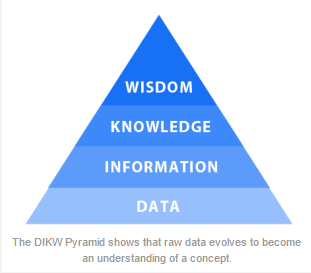
The DIKW Pyramid makes it much easier to analyze and understand the process through which data is transformed.

dikw pyramid

Business 2 Community provides us with a salad metaphor to describe the DIKW pyramid levels:

Data: I have one item. The data displays a 1, not a zero.
Information: It’s a tomato. Now, we understand the item and its characteristics.
Knowledge: A tomato is a fruit. We can identify patterns in the information and apply them to the item.
Wisdom: Tomato is never added to a fruit salad. There is an underlying, commonly understood principle that governs the item’s purpose.

B2C explains further by claiming that “bad data costs time and effort, gives false impressions, results in poor forecasts, and devalues everything else in the continuum.” Therefore, it’s necessary that the data your business collects allows for accurate and efficient analysis. Otherwise, your choices won’t be of the highest quality possible, and they could affect the functionality of your business in the future.

On the other side of the coin, if your technology is operating at maximum efficiency, and your communications are properly planned and managed, the chances of your data being affected by leaks or corruption is significantly reduced. As shown by the DIKW pyramid, data is the foundation for a business. Without it, you cannot hope to continue. NuTech Services can help your business ensure that your data is safe and available when you need it with our Backup and Disaster Recovery solution. Give us a call at 810.230.9455 to learn more.