

b2ap3_thumbnail_how_are_you_storing_data_400.jpg

What’s the Best Way to Store Your Company’s Data? Find Out!

b2ap3_thumbnail_how_are_you_storing_data_400.jpgMarch 31st is World Backup Day! This occasion begs the question, “How much thought have you put into where your data is stored?” If you haven’t thought through your data storage options, then your files may be located in several different places. This could make accessing your data difficult, as well as jeopardize your network’s security. To get you started, let’s take a look at these four data storage options.

Storing Your Data Locally
The most common way for businesses to store their data is over their internal networks, like on in-house server units and workstations. Storing information locally offers companies the most control over their data, and with the right protections in place, it can be a very secure option. However, as is the case with every data storage scenario, if security isn’t given enough attention, then storing data locally can actually put your information at risk. One advantage of utilizing an internal network for data storage is a quick and reliable connection that’s not dependent upon the Internet. Although, this is at the financial expense of having to maintain your own IT infrastructure, which includes workstations, cables, server units, routers, and more.

Storing Your Data in the Cloud
Storing data in the cloud is an option that’s grown tremendously for businesses of all sizes. The advantage of the cloud is that it offers organizations anytime/anywhere access to their data, which is super convenient when dealing with multiple office locations and remote workers. Plus, the fact that you don’t have to maintain your own IT equipment will save you a boatload on your operating budget.

On the control side of things, storing your data in the cloud makes you dependent upon the policies of your cloud service provider. This is why it’s important to find a cloud provider that best suits your company’s data needs, instead of just going with the first provider that comes along. The same can be said of cloud security. If you’re dealing with sensitive information or data that requires strict security protocols, then you’re going to want to work closely with your cloud service provider to cover your bases.

Storing Your Data Off-Site
Off-site data storage is similar to storing your data in the cloud. You can access it from a remote computer, and with a reliable connection, it will be there when you need it. One of the most popular uses for off-site data storage is backing up data. For example, if a disaster strikes your company’s office and damages your in-house IT infrastructure, then you’re going to be glad that your data is off-site and safe.

Backup and Disaster Recovery
One great tool that takes advantage of storing your data both in the cloud and locally is a Backup and Disaster Recovery solution. BDR takes multiple snapshots of the data on your network and sends them to the cloud where they can be quickly retrieved, should you ever need it. Plus, if your server unit stopped working for any reason, BDR can then serve as a temporary replacement while the server issue gets resolved. This kind of convenience is possible thanks to BDR’s ability to securely store your backed up data off-site, and have it be available for when you need it the most.

For more information about data storage, the cloud, and BDR, give NuTech Services a call at 810.230.9455.

b2ap3_thumbnail_no_internet_400.jpg

Tip of the Week: 3 Ways to Be Productive When Your Internet Connection Fails

b2ap3_thumbnail_no_internet_400.jpgModern businesses are reliant on certain parts of their infrastructure to keep operations functioning. For example, if your building’s electricity were to go down, what would you do? What about if you lost Internet access? Would your business be able to keep your employees busy, or would the downtime experienced be enough to cause panic?

One might understand why a lack of power could lead to downtime, but an Internet connection? Many modern organizations run their infrastructure out of the cloud, which requires an Internet connection to access. If this is the case, productivity grinds to a halt, and you won’t be able to access critical files or applications. The fact of the matter is that your business should be prepared to deal with worst-case scenarios like this, even if they’re unlikely. You should have a plan for how to handle a loss of an Internet connection.

So, what exactly can you do if your business’s office loses power or your Internet is down for a significant period of time? You only want to send your employees home for the day if they can’t get any work done at all. If you anticipate that the power outage or downed Internet will only last for an hour or two, that’s time that can be spent on other in-house tasks that you might put off from time to time.

Here are a few ideas that might help you get through the day without letting downtime kill your bottom line.

Hold Staff Meetings
If your staff meetings don’t require the use of technology, what better time to hold them than when the Internet or electricity is on the fritz? This way, you can address important initiatives, team building, or problems within the office, without allowing your team to waste time. Think of it as a really convenient inconvenience!

Organize or Clean the Office
You know what they say; if you have time to lean, you have time to clean! If you’ve been looking for an opportunity to organize files or clean up a certain part of your office, there’s no better time to do so than during downtime. If your team needs an excuse to stay in the office to make their rent, mortgage, car payment, etc, put them to work.

Perform Employee Evaluations
Similar to how you can hold staff meetings during an outage, you can also do employee evaluations. Take some time to critically evaluate your employees and let them know how they’re doing. Ask them what’s working for them, what can be improved upon, and why. By the time you’ve finished, you’ll have a better idea of how your team is doing, and what you can do to make it better.

When All Else Fails, Send Your Employees Home
If the downtime just seems like too much to bear, there’s always the option of having your employees go home for the day. However, this might not feel like an option, especially if you have important work that needs to be done. You need to ask yourself if letting them stick around is worth it or not. For some businesses, a workday without the Internet may be shot and calling it a day may make the most sense for your bottom line.

While making the best of downtime might be your only option, at NuTech Services, we consider downtime to be an emergency. If your network or a critical part of your IT infrastructure goes down, leaving your employees high and dry, our technicians go into emergency mode.

Want to learn how we can help your business prevent downtime? Give us a call at 810.230.9455 for an IT assessment and give us the opportunity to show you how to always be productive and profitable.

b2ap3_thumbnail_cybercrime_black_market_400.jpg

Drugs, Assassins For Hire, Weapon Sales, and More: All Conveniently Found On the Web

b2ap3_thumbnail_cybercrime_black_market_400.jpgThe Internet is a fascinating and wonderful place full of great, informative resources and websites, but it’s also home to online markets for illegal and unethical practices. These hotbeds of criminal activity are a danger not only to your business, but to everyone who uses the Internet.

Specifically, the Internet (or what’s known as the “dark web”) is often used to anonymously distribute drugs, data, and other questionable activity. The Internet itself allows for anyone to take on a pseudo-anonymous nature, but there are other, much darker parts of the Internet that can only be accessed if you’re truly anonymous. Users who are using the anonymity browser Tor can go about their business on the dark web with little to fear. Many online black markets will only allow users to access them if they’re using Tor, primarily because they want to dodge law enforcement as much as possible.

Not all online black markets take this same precaution, though. Some illegal online markets don’t care about staying available to their buyers or hidden from the authorities, and will even sell to the common masses rather than hardened criminals. This sporadic and unpredictable behavior is one reason why everyone should be concerned about the dark web. Since these underground black markets are often available via the “surface web” (the part that the average user sees), this increases the range and scope of who criminals can target with their goods, which allows the cybercrime industry to thrive.

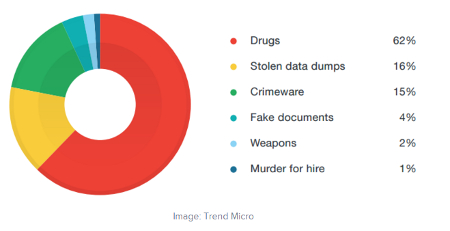
From Trend Micro via TechRepublic, here’s a chart detailing what the online crime market is primarily used for.

ib stats

Drugs are one of the biggest components of the online cybercrime industry, but stolen data dumps and crimeware are the second and third largest threats, respectively. A surprising factor, however, is the presence of illegal online arms manufacturing, and even assassinations. When you consider the fact that anyone can access these assets through the surface web, it’s a frightening concept indeed.

The North American underground dark web network is generally considered what’s called a “glass tank.” It might be useful for its intended purpose, but it’s so transparent and fragile that it can shatter and break at any given moment. Trend Micro reports that the life cycle of most black market sites is very short. The sites could be available one moment, and gone the next.

If you take away anything from this blog article, it’s that cybercriminals are as resourceful as they are slippery, and that they’ll use any means necessary to make a quick buck. This includes selling information they’ve stolen from businesses just like yours on the black market, or selling malicious code to would-be hackers. Business owners need to be exceptionally cautious when dealing with criminals on the Internet, simply due to the fact that they’ll attack for no other purpose other than to cause a little bit of chaos and to throw your sensitive data in the “for sale” window. It’s important to remember that there is, in fact, a market for your stolen data, and that hackers will do whatever it takes to breach your systems and make money off of your misfortune.

NuTech Services knows how to handle the security threats that your business faces every day, and we can outfit your network with the solutions required to eliminate and detect issues before they become bigger problems. Furthermore, we can protect your organization’s end-users from accessing infected or suspicious sites, like potentially malicious web pages, or those designed to sell questionable goods. Perhaps the best way we can protect your business is by offering enterprise-level security solutions, like firewalls, antivirus, content filtering, and spam blocking solutions, effectively mitigating the odds of your business falling prey to a hacking attack.

For more information, give us a call at 810.230.9455.

b2ap3_thumbnail_stolen_data_problems_400.jpg

736 Million Records Were Exposed to Data Theft in 2015

b2ap3_thumbnail_stolen_data_problems_400.jpg2015 saw a significant increase in high-profile hacking attacks in organizations of all disciplines: healthcare, government, and even large entertainment companies all fell victim to data breaches. In light of these attacks, valuable lessons can be learned through analyzing the types of records that were stolen. In 2015, over half of all records exposed to hackers were passwords and email addresses.

Take a moment to consider the importance of such credentials; they’re used for accessing online accounts and mission-critical information that’s stored on company networks. If hackers and thieves gain access to them, they essentially acquire unrestricted access to certain accounts that may be critical to the functionality of your business. Plus, since many users use the same password across multiple accounts, having one set of credentials may give hackers a lot of access.

Here are some of the statistics revealed by the Risk Based Security report:

  • In 2015, there were 4,000 reported data breaches, which exposed 736 million records.
  • 40.5 percent of reported incidents occurred in organizations within the United States, with the amount of data stolen totaling around 65 percent of the data stolen throughout the entire year.
  • 238 million stolen data records came from just four huge data breaches.
  • 142 organizations experienced multiple data breaches in 2015.
  • The US and UK combined made up 45 percent of all reported data breaches in 2015.

What You Can Do About It
If you want to keep your business safe from the seemingly endless horde of malware on the Internet, you need to be tirelessly working toward integrating proactive security solutions designed to protect your network from potential threats. One way that you can do so is by implementing powerful security measures that are designed to both prevent threats from accessing your network, and detect them from within before they cause unspoken amounts of damage. Enterprise-level firewall and antivirus solutions are great tools meant to prevent breaches, while content filtering and spam blocking solutions make your network even more resilient. These four technologies are what’s known as a Unified Threat Management solution, and it’s a critical investment for any security-minded SMB.

Another way that you can decrease the chances of being hacked is by using complex passwords that are difficult to guess, and to change these passwords consistently. Your passwords should always be long, utilizing lower and upper-case letters, numbers, and symbols. Never use the same password and usernames for multiple online accounts. Always use different credentials. If you have trouble remembering everything, an enterprise-level password manager is a great way to securely store your credentials.

In the end, it comes down to how well you protect your organization from threats. NuTech Services can educate your business on security best practices, while assisting you with the implementation of comprehensive security systems. Our solutions are designed to minimize the chances of data breaches, and to immediately resolve problems that might come up.

For more information, give us a call at 810.230.9455.

b2ap3_thumbnail_backup_system_400.jpg

The Strict Security Measures of Nuclear Power Plants Can Benefit Your Business Too

b2ap3_thumbnail_backup_system_400.jpgTechnology, while a great asset that can be leveraged for your benefit, can also frighten businesses due to how unpredictable it can be at times. The constant threat of data loss, identity theft, and hardware failure can cripple your business’s ability to retain operations. Specifically, businesses can learn about risk management by analyzing the processes used by an industry where risk management is absolutely critical: nuclear power plants.

In the wake of two of the most destructive and violent nuclear disasters, nuclear power plants have begun to crack down on how they approach risk management. The Chernobyl incident of 1986, as well as the tsunami-induced disaster at Fukushima in 2011, are the only nuclear disasters to reach the peak of the International Nuclear and Radiological Event Scale (INES) at a rating of 7. This means that they had an immense impact on the immediate vicinity, as well as the environment on a worldwide scale.

The meltdown at Chernobyl was the result of an uncontrolled nuclear chain reaction, ending in an enormous explosion that resulted in fire raining from the sky and radioactive core material being ejected into the vicinity. A closer inspection of the incident revealed that the explosion could have been prevented, had the plant practiced better safety measures and risk management, like having a containment system put in place for the worst-case scenario.

In comparison, the Fukushima plant was prepared to deal with a failure of operations. The problem that led to a disaster was one which couldn’t possibly have been prevented: the 2011 Tōhoku earthquake and the resulting tsunami. The Fukushima plant had a contingency plan to shut down the plant in the event of a disaster, but of course, the tsunami prevented this from happening properly. Flooding damaged power lines and backup generators, which led to heat decay, meltdowns, and major reactor damage.

Disasters like these lead to professionals searching for ways to prevent emergency situations in the future. For example, the Fukushima incident kickstarted thought for how to prevent problems caused by the unexpected issues. In response to emergency power generators being flooded or destroyed, off-site power generation will be implemented as soon as November 2016.

One other way that nuclear plants have chosen to approach these new risks is by outsourcing this responsibility to third-party investigators, whose sole responsibility is to manage the reliability of backup solutions. In a way, these investigators function similar to a business’s outsourced IT management, limiting risk and ensuring that all operations are functioning as smoothly as possible.

What we want to emphasize to you is that businesses in industries of all kinds expect the worst to happen to them, and your business can’t afford to be any different. Taking a proactive stance on your technology maintenance is of critical importance. While your server that suffers from hardware failure might not explode and rain impending doom from the sky, or expel dangerous particulates into the atmosphere, it will lead to significant downtime and increased costs.

In order to ensure that your business continues to function in the future, NuTech Services suggests that you utilize a comprehensive backup and disaster recovery (BDR) solution that minimizes downtime and data loss risk. BDR is capable of taking several backups a day of your business’s data, and sending the backups to both the cloud and a secure off-site data center for easy access. In the event of a hardware failure or other disaster, the BDR device can act as a temporary replacement for your server. This lets your business continue to function while you implement a suitable replacement.

Plus, NuTech Services also offers a remote monitoring and maintenance solution that allows us to work just like the investigators who work for nuclear plants. We manage and maintain your IT in a way which is designed to detect and prevent major problems, allowing you to work unhindered. We can remotely administer patches and security updates to ensure the continued functionality of your hardware and software solutions.

For more information, give us a call at 810.230.9455.

b2ap3_thumbnail_remote_working_400.jpg

3 Technologies That Will Give Your Remote Workers the Edge

b2ap3_thumbnail_remote_working_400.jpgMore businesses than ever before are finding value in allowing their workers to work from the comfort of their own homes, rather than have them drive all the way to the office to do a job that can be done from anywhere with an Internet connection. More importantly, it’s much more cost effective for businesses to allow for remote workers. How can you make it as easy as possible for remote workers to get their jobs done?

Wait, why would you want to let your employees work from home in the first place? A lot of it has to do with cutting utility costs and other expenses, like hardware purchasing and energy expenses. If your team isn’t in the office, you can save on electricity and (depending on your location) heat or air conditioning. Plus, when employees feel good, they’re more likely to work hard, improving the quality of their work.

Here are three technologies that can help your remote workers get the most out of their workday.

Virtual Private Networks (VPNs)
One of the most common problems for remote employees is that they need to access files that are stored locally on their company’s network. Since these employees aren’t based out of the business’s office, they won’t be able to access them in the traditional method. This can prevent them from doing their jobs properly, especially if there are critical files that need to be used for their daily tasks. A VPN allows your remote employees access to files on the company network securely. This helps to ensure that your team stays productive, without compromising your data’s security.

Cloud-Based Applications and Virtualization
The cloud allows for information and applications to be deployed via the Internet, which means that anyone with a stable Internet connection can access files or applications necessary to complete their day-to-day tasks. The cloud, in general, is a handy tool that can help you minimize your in-house IT footprint and improve data deployment, allowing your team to work from anywhere in the world that has an Internet connection; including on the road or on business trips.

Voice over Internet Protocol
Communication is yet another pain point that remote workers have trouble with. If your team needs to make frequent outbound calls, you want them to have a phone number that can be tied to your business. Furthermore, if you need to contact someone on your remote team, you expect them to be available through email, instant messaging, or via phone. With a Voice over Internet Protocol (VoIP) solution, you can transfer your voice over the Internet, essentially providing instantaneous communication via both voice or video chat.

Ultimately, it’s your responsibility as a business owner to provide your team with the tools required to perform their daily duties, even if they work remotely. If your business is trying to achieve better operations via a remote workforce, contact NuTech Services, we can help! 

b2ap3_thumbnail_these_old_pcs_400.jpg

3 Billion Users May Have Good Reason to Avoid Upgrading Their Old PCs

b2ap3_thumbnail_these_old_pcs_400.jpgAny user of technology knows the frustration of periodically replacing it with better and more recent technology. In fact, the latest gadgets seem to be outdated just months after they’re released. Many people believe that this unprecedented growth in the technology industry could lead to a decrease in PC sales, but it also means that devices are growing more reliable.

According to a study from Intel, there are over a billion PCs in the world that are three years old or older, with around half of those being up to four or five years old. Those who enjoy the latest and greatest technology understand this dilemma. In just a year or two, these PCs could be rendered obsolete by breakthroughs in computing technology. However, thanks to the increased longevity of technology, this is no longer a problem. Many PCs from the last five years are capable of handling a lot more than those from ten years ago, but most importantly, recent PCs are displaying significantly more reliability, which leads users to forsake purchasing new technology in favor of keeping their older devices. You know what they say, “If it ain’t broke, don’t fix it.”

Another problem facing the commercial PC industry is that technological growth has slowed significantly in recent years. Though there’s still progress being made, it’s not coming as rapidly as it was in previous years. However, as previously mentioned, the need for new technology is dwindling, as technology grows more reliable and doesn’t need to be replaced as often. As reported by ZDNet:

Sure, on paper it’s going to be advertised as being faster, and benchmark tests will support this, but in the real world – assuming that the old one isn’t all kludged up and ailing – you’re just not going to see much difference. Sure, there might be a slightly faster boot up time, or it might be a little snappier, but most of the gains that new PC owners see are nothing more than confirmation bias. Sure, if you go to the performance end of the scale then things are different, but you average home or office PC spends most of their time running a web browser or a word processor application. A three-year-old PC can do that without breaking a sweat.

Basically, users will generally replace their PC with a new one that can perform, more or less, the exact same function, only better. When people have to do this, they think that it’s not worth the investment, since they get the same function without the up-front expenses. This makes sense from an owner’s point of view, since there’s no reason to replace a perfectly fine piece of technology. Doing so can easily break a budget if it’s not planned out properly beforehand. Furthermore, legacy applications are an issue, especially if you haven’t upgraded your technology since you first opened your doors for business. Upgrading without the necessary precautions could prevent your staff from accessing critical hardware and software systems required for operations.

Often times, issues with a slow computer or sluggish performance don’t necessarily facilitate the purchasing of new technology. The root of the problem could be just a single component of your workstation, like a failing hard drive or a bad stick of RAM. Addressing these issues is often much more budget-friendly than completely replacing an entire workstation, so make sure to check for these possibilities before going all-in. If there’s nothing wrong with your hardware, the problem could even extend to a software issue, like a need for routine maintenance or driver updates. It’s best to have a trained technician on-hand who can diagnose these problems for you.

Even if your organization’s current technology is fine, we’ll always advocate for organizations like yours to take full advantage of the latest technology solutions. Doing so can provide a competitive advantage for your business. In today’s business world, you need all of the help you can get, and NuTech Services is more than willing to help you surpass other Michigan businesses.

If anything, the fact that PCs aren’t getting replaced as often means that your workstations will need more attention in order to continue functioning properly. Outsourcing this responsibility to NuTech Services is your best shot at doing so. To get started, all you have to do is call us at 810.230.9455.

b2ap3_thumbnail_business_continuity_400.jpg

Business Continuity: Prepare For the Worst and Hope For the Best

b2ap3_thumbnail_business_continuity_400.jpgThere are few things more important than the continuity of your business. Your livelihood, and that of your employees, depends on the continued functionality of your organization. Therefore, it becomes necessary to do all that you can to ensure your business is protected from an unexpected downfall, due to data loss, natural disasters, and other means.

Business continuity, despite the fact that it’s hugely important, can often be neglected due to more pressing matters. For example, dealing with small issues that pop up periodically might feel more important than worrying about a huge data loss disaster. In cases like this, it’s always best to be prepared. You should approach business continuity from the viewpoint of Murphy’s Law: “Anything that can go wrong, will go wrong.” Your organization should be prepared to handle anything and everything that the universe throws at it.

Natural Disasters
We all know that floods, fires, and electrical storms are often beyond the control of human action. A freak tornado could strike and level your office at any time, or a bad storm could topple power lines and the impending power outage could cause damage to your technology. A natural disaster doesn’t have to destroy your office; all it has to do is cause enough damage to make getting back to normal operations difficult. This is the most common problem stemming from natural disasters.

You can reduce the pain of this by integrating some relatively common technology solutions, like an uninterruptible power supply (UPS). If your IT infrastructure is suddenly cut off from electricity, the UPS will send a signal to the server, telling it to shut down normally once all work and applications are properly finished and closed.

Succession Planning
This is perhaps the most neglected part of planning for business continuity. Many organizations have important staff members that have been around for what seems like forever, but it won’t always be this way. Making sure that critical personnel remain at the company can seem daunting, especially if you’ve never given a thought to what would happen if they left. When we say “leave,” we usually mean one of three things: 1) The employee quits, 2) The employee is severely ill and away from the office for an extended period of time, and 3) The employee dies.

We don’t want to sound morbid, but again, you should always prepare for the case when important people aren’t available anymore. Establishing a policy for succession beforehand can help to ensure that your organization is prepared for anything. Even something as simple as cross training can contribute to this goal.

Data Loss and Disaster Recovery
Data loss is a primary reason a business fails to continue operations, and as such, making sure that it’s mitigated is a primary function of any good business continuity plan. Organizations that fail to restore their data following a data loss disaster are likely to go out of business within a year, so you know that data loss is no joke.

Thankfully, it’s easy to integrate data backup with help from professionals like NuTech Services. Our data backup and disaster recovery service is designed to help small and medium-sized businesses avoid data loss and get back in the game as quickly as possible, following a data loss incident. Your data backups will be sent to secure, off-site data centers, where they can be quickly recovered in the event of a disaster. The BDR can temporarily act like a server to help your business continue functioning, even while you’re searching for new technology to replace the downed server.

Some folks might think we’re being paranoid, but honestly, preparing for the worst only means that you can move forward with confidence, knowing that even the worst possible circumstances can’t take your business down. If you’re ready to embrace business continuity, give NuTech Services a call at 810.230.9455.

b2ap3_thumbnail_risk_factors_for_employees_400.jpg

You Might Be Surprised At the Ways Your Employees Put Your Data At Risk

b2ap3_thumbnail_risk_factors_for_employees_400.jpgOctober is Cyber Security Month and we want to use this time to bring awareness to the different aspects of cyber security. One often overlooked element of cyber security is employee risk management. What level of risk does your staff pose to your network’s security? You can easily find this out by taking an online test.

This employee risk assessment tool is brought to you by StaySafeOnline.org. It’s a quiz designed for employees to take so they can better understand how their use of technology may be putting their organization at risk. The quiz asks employees questions about how they use their mobile devices in the workplace, how they share data, along with other questions meant to reveal security best practices. The employee risk management test can be found here:

http://www.emc.com/microsites/workplacesecurity/index.htm

At the end of the test, the online tool will calculate the test taker’s risk score, and every manager knows how powerful a motivator it can be to rank people. What makes this tool so valuable is that it’s designed to educate your workers about best practices. Once they understand exactly how their “bad behavior” is putting the company at risk, they’ll then feel compelled to change their ways. This is a much more effective tool than yet another memo to read about why cyber security is important.

As great of a security tool as this is, it won’t solve all of your cyber security woes. Even if you’ve got your entire staff lined up on how to properly use their technology, you’re still putting your business at risk if you don’t have the proper protections in place. If your business doesn’t have a strong firewall or up-to-date antivirus software, then even the most careful workers can put your network at risk. Implementing proven security solutions like a mobile device management solution or a Unified Threat Management tool will make your network virtually impenetrable when combined with a workforce that’s educated on security best practices.

For a security assessment that goes even more in depth than an online quiz, give NuTech Services a call at 810.230.9455. We offer businesses a security service called penetration testing where we seek out every weak point of your network for the purpose of offering solutions to best protect your company’s data. Call us today and quiz us about what we can do to keep your information safe!

b2ap3_thumbnail_companys_it_budget_400.jpg

3 Benefits of Outsourced IT That Let You Do More For Less

b2ap3_thumbnail_companys_it_budget_400.jpgCost drives business, this much cannot be denied. When the technology your business relies on fails, you have to get it repaired or replaced quickly in order to keep the resulting downtime from damaging your business. The traditional method of computer repair is much like when your car is in disrepair. When your technology isn’t working properly, your organization reacts to the problem by calling your friendly neighborhood computer repair guy.

The technician will come to your office and try to fix the technology that is broken. When they figure out they can’t fix the problem on the spot, they will give you a quote. The time and materials of summoning these technicians to the office will cost you money, so will the replacement technology, and most notably, the downtime you accrue. Add that to the variable cost of fixing the malfunctioning technology, and your business has a real problem.

At NuTech Services, we offer a proactive IT support platform that utilizes remote monitoring and management software to ensure that the technology that’s attached to your network, and your network itself, is up and working properly. Additionally, our whole IT services platform is billed in one monthly payment.

If you add it up, you are saving money in every aspect of your business. You not only remove the variable costs of keeping your IT running smoothly, you also get proactive support that in many cases gives you the time to replace hardware BEFORE it fails, saving you from the doldrums of company wide downtime.

The fact is that small and medium-sized businesses need to cut their technology support costs if they want to compete with larger organizations. There are a myriad of benefits that come from a managed services provider like NuTech Services handling the administration and support of your technology. Besides the obvious cost savings, two other huge benefits include:

  • Comprehensive Support: A major speedbump SMBs have when shopping for any service that claims to help their business, is the quality of that service. For those that worry that our managed services are too good to be true, we employ certified and trustworthy technicians that are proficient in finding solutions for today’s most challenging business technology problems.
  • Single Point of Contact: As an alternative from having to manage several vendors, our IT service offering provides you with a single point of contact for all of your technology needs. Since we understand the intricacies of your network, we can get issues resolved faster.

Managed IT services can provide you with many other benefits as well. For more information about how our managed IT services can benefit your organization, call us at 810.230.9455 today.

b2ap3_thumbnail_technology_innovation_for_business_400.jpg

3 Ways to Make Innovation a Priority For Your Company

b2ap3_thumbnail_technology_innovation_for_business_400.jpgHow difficult is it for your organization to innovate and come up with new ideas? Sometimes it might seem impossible when it feels like all the good ideas are already taken. Normally, advancements in technology are a primary fuel for innovation within a company. If you aren’t feeling inspired, there are several new ways you can approach innovation. Here are three ideas.

If you ever feel that you aren’t making enough of a splash in the market, just remember that you’re not alone. Many organizations often have the same issue when it comes to innovation. Just like inspiration, it comes and goes in cycles. When a business grows, it might lose track of finding better solutions due to their continued success with proven solutions that work. This can hinder their ability to further expand. You’ve heard the saying, “Without risk there is no reward,” and in this case, it’s true.

Innovation and Acquisition
One way you can improve innovation in your company is through acquisition. The downside of innovation via acquisition is that it can be costly and difficult to get used to. There’s the cost of purchasing a company, as well as two different business models that might conflict. You can’t just buy a company and force it to comply with your current strategy right off the bat. Plus, if you’re having trouble with innovation, and you try to impose the same principles upon your purchased company, they’ll also have trouble with innovation, making it even more difficult to get anything done. The innovation will be short-lived or nonexistent, and you’ll be stuck with the same problem you had in the first place, only with a lot less coin in your pocket.

Take, for instance, Dell’s acquisition of certain aspects of IBM servers. This is the proper way to fuel innovation through acquisition. Find the value that you’re looking for in an acquisition, and hold onto it. Protect it and let it transform the way your organization does business. Use your available resources to help the endeavor succeed.

Skunkworks: Groups Focused on Innovation
Another way to enhance innovation is through the concept of skunkworks. This is when you put together a team that specializes in the concept of innovation. By creating a separate firm within your organization dedicated to coming up with game-changing ideas, you clear them to create and implement ideas that aren’t restricted by your corporate policies, effectively allowing the skunkworks group to act as a startup. One example of this is how EMC’s Pivotal Labs functions in order to create new products.

Innovation and Friendly Competition
Sometimes all innovation needs is a gentle push in the right direction from internal competition. In order to foster innovation in this fashion, you can use certain competitions designed to reward workers with bonuses. Or, you can use your local competition to fuel innovation similar to the way Dell does with its annual Innovation Day. It’s a reality show-like program where multiple companies compete for a fully-funded innovation trial. The winning company gets the prize of springboarding into a full-sized company which includes further funding. An incentive like this is sure to motivate your team.

Ultimately, one of the best ways you can boost innovation is by fueling it with technology best practices. NuTech Services can equip your business with the technology to develop new ideas. Give us a call at 810.230.9455 to learn more.

b2ap3_thumbnail_angry_customers_400.jpg

You Can’t Afford to Ignore a Ticked Off Customer

b2ap3_thumbnail_angry_customers_400.jpgHaving confidence in your ability to run your business is an important thing to have, but it doesn’t matter how much confidence you have if your customers beg to differ. After all, without them, your business wouldn’t be where it is today. This is why it’s important to listen to what your customers say, and if it’s not positive, you need to resolve the problem as quickly as possible.

The reason you need to fix problems with upset customers (sooner rather than later) is largely based upon how connected today’s generation is thanks to the Internet. Users can share their experiences in the blink of an eye. If their reviews are good, then great; you just got a repeat customer. However, if they aren’t happy with the services rendered, you can be sure that the Internet will hear about it, and the rest of the world by extension.

How Customers Build Your Business
As a business owner, you share a symbiotic relationship with your customers. They require a service, and you provide them with a quality solution to their predicament. Your organization can’t survive if you have no customers, which means that you need to make sure that they’re satisfied if you want to stay in business.

According to Vision Critical, it takes somewhere between 10-to-12 positive reviews to make up for one negative review. What’s worse is that 80 percent of people won’t buy products or services from a business with negative reviews. If there’s anything that can cause the death of a company, it’s a lack of customers and a lack of business.

Other statistics concerning unhappy customers include:

  • Customers are three times more likely to tell their friends about negative experiences, be it on social media or through word of mouth.
  • Businesses with an average of three stars or more on Google Places get 87 percent of all clickthroughs.
  • Restaurants in the Seattle area reported 5-to-9 percent increases in revenue gained following positive reviews on Yelp.

A Ton of Cash is Lost Due to Unhappy Customers
Because of the extremely competitive nature of business, customers who you can’t satisfy will probably ditch you and find someone who can. You’d be surprised how much profit is lost every year to unhappy clients. Here are some rough statistics that explain how much unhappy customers can cost your business.

  • In the U.S. consumer market alone, there’s around $1,300,000,000,000 on the line. Yes, you read that right: trillion, with a capital “T,” and thirteen figures.
  • 51 percent of customers will switch businesses or service providers due to poor customer experience.
  • 81 percent of customers who switch businesses claim that the company could have prevented them from leaving.
  • Totaled together, that’s approximately $537,030,000,000 lost by unhappy customers every year.

It’s understood that customers who are satisfied with your services will generally contribute more cash (up to 14 times more) than a dissatisfied customer. In most cases, it’s much more lucrative to retain your current customers than acquire new ones. It costs 6-7 times more cash to generate new leads than it does to keep your current customers. If you take care of your clients, they’ll repay your business in kind with their continued loyalty to your brand.

What are some of your favorite ways to show your customers you appreciate them? Let us know in the comments.

b2ap3_thumbnail_sow_the_seeds_of_business_400.jpg

“It’s Dead Jim:” When to Walk Away from Your Failing Business

b2ap3_thumbnail_sow_the_seeds_of_business_400.jpgRunning a business can be an exhilarating experience, mainly due to the degree of risk that’s involved. When you’re the one calling the shots, your success is only limited by your ability to lead. Then there’s the chance that things won’t work out and you’ll fail miserably. When your business goes the way of the latter, how do you know when your your company is finished and it’s time to call it quits?

If you’re stuck in a hopeless situation, it’s better for your personal sanity to throw in the towel than it is to try and stick it out and make it work. To discover if you should hang in there or close up shop, ask yourself these three questions.

Do You Enjoy What You’re Doing?
Granted, few people actually love every minute of their job; by its nature, work comes with a level of discomfort. Obviously, you should expect some hardships when running a business. To get more specific, the question we’re asking here is, “Have you reached a point where you hate every minute of being a business owner, even to the point where you can’t find any reason to celebrate?” If you’ve reached the point where you can’t get any satisfaction from something that requires so much from you, it’s time to leave your company and seek out something more fulfilling.

Although, if you truly believe in the mission of your business, then you’ve got what it takes to make it through a hard spell and see a problem through to the end. Digging down deep and tapping into your passion to do what you do, and not letting your dreams just be dreams, is what will carry you through a rough patch and lead you to success. This principle quickly becomes evident after talking to any successful leader in your industry who has been where you are today.

Are You Connecting With Your Market?
You might have a business idea that you’re extremely passionate about and believe in wholeheartedly, but if it’s not connecting with your target market, then it might be time to invest in a different idea. That doesn’t mean you shouldn’t stop doing what you love; it just means that, perhaps it would be wiser to have your passion be a hobby, instead of a business for which your livelihood depends on.

Before you give up on a dream because the market isn’t coming around, try taking a different approach and do what you’re doing in a different market. Or, try taking surveys of your target market to find out what they’re really looking for. Of course, if making a major change like this still fails to yield the results you need to be profitable, then maybe your great idea is only great in your head and you should call it quits.

Is it Meant to Be?
Call it fate, or a deep intuition, or even a bad economy, but sometimes seemingly-good ideas just aren’t meant to be. If it feels like nothing is ever going your way and the universe is out to see you fail, well, then maybe it is. Instead of fighting fate, it may be better to just throw up your hands, accept fate, and give up. Who knows, maybe your business can be sold or acquired and you can walk away with some cash in your pocket.

Of course, by their nature, business owners have a can-do attitude and won’t give up until they’ve tried everything they can in order to make their dreams come true. To that end, NuTech Services can arm you with a host of solutions that will streamline operations and provide answers to many of your most pressing problems. After all, it would be a shame to call it quits because you’re stuck on something that could easily be prevented with the right technology.

To learn how technology can help your business climb out of a rut and get back on the fast track to success, give NuTech Services a call at 810.230.9455.
b2ap3_thumbnail_workers_engaged_400.jpg

Tip of the Week: Keep Your Employees By Keeping them Engaged

b2ap3_thumbnail_workers_engaged_400.jpgAs far as you’re concerned, managing a business is a highly engaging job. However, your staff might feel differently about their jobs. According to a recent study by Deloitte Global Human Capital Trends, only 13 percent of employees are legitimately engaged in their work. A disengaged worker is a serious problem for any workplace.

Obviously, a disengaged worker will give a subpar performance, or, “half-assing it,” if you will. However, if they are still able to meet quotas, then this disengagement problem won’t be felt immediately, but it will cost you in potential revenue. In that, a bored worker won’t “give the job their all” and make you profits that go beyond your expectations.

The study goes on to point out that a disengaged worker can be more harmful to a company than you might expect; more than 25 percent of disengaged workers will negatively affect their co-workers. In other words, their negativity will spread, causing more of your workers to disengage with their jobs. If left unchecked, these poor attitudes will eventually bring the morale of your office crashing down, like the Hindenberg.

For your consideration, here are more sobering statistics from the study:

  • 86 percent of companies suffer from an inadequate leadership pipeline.
  • 79 percent have retention and engagement troubles (i.e. high turnover rate).
  • 75 percent have significant trouble attracting the employees they need.

Judging by these numbers, it becomes obvious that employers carry the bulk of the responsibility when it comes to motivating their workforce. By not taking proactive measures to engage your employees (instead, assuming that “If I love my job, then my employees must love theirs,”), then you may one day find yourself blindsided when a poor attitude spreads and the majority of your staff are disengaged. This makes the office a rather drab place to conduct business.

What Causes a Worker to Lose Interest?
While every person has their own reasons for “checking out” from their job, one common reason is that the job fails to provide the worker with personal meaning and fulfillment that they were perhaps looking for when they first applied. You know the story; a bright-eyed job applicant interviews with high hopes. You hire them, expecting that enthusiasm to channel into their job performance; but, at the end of the year, their work has become sloppy and they’ve caught a poor attitude from your other miserable, disengaged workers. If this is a familiar scenario for your office, then it’s on you to motivate your team by rekindling the spark that originally caused them to want to apply for the job.

Another theory about what causes workers to disengage with their job isn’t that they’re doing too little, but rather, they’re doing too much. In fact, two-thirds of all employees in the U.S. feel like they’re doing too much work for too little pay. This grim statistic factors into another reality about the US workforce, which boasts a 26 percent worker turnover rate. It stands to reason that a worker who is fully engaged with what they do, and isn’t burnt out from being overworked, will stick around longer and churn out a higher-quality product.

What You Can Do about It
As stated earlier, if you’ve got a handful of disengaged workers, you will want to take action to engage them. Otherwise, dissension will spread amongst your ranks. Therefore, the problem of employee disengagement boils down to leadership. A skilled leader will be able to spot a worker that’s “checked out” and do what it takes to engage them and maximize their potential.

To that end, here are six tips from Forbes on what “Wise Leaders Can Do to Engage Their Employees.”

  • Stop unknowingly creating tension by expecting them to behave a certain way, rather than allowing them to be their authentic selves.
  • Detect the most positive capabilities in people.
  • Stop micromanaging and start empowering them to discover their full potential.
  • Put employees in a position of influence and allow them to discover their own potential.
  • Share your success to build their momentum.
  • Be consistent and have their backs.

As an IT company, we want to add to this list the importance of providing your staff with working technology. Using slow and unreliable computers is a sure-fire way to frustrate your team, causing them to disengage. If they have to fight with their technology to do their jobs, they will care less and less about their jobs. In fact, they may even take your lack of provision to mean that you, as their leader, don’t care, and a disengaged attitude is excusable.

NuTech Services is here to help you on the technology side of motivating your staff. If you know of any additional ways to motivate your workers, share them with us in the comments.

b2ap3_thumbnail_boss_monitoring_400.jpg

How to Monitor Employee Communications Without Taking What’s Said Personally

b2ap3_thumbnail_boss_monitoring_400.jpgThere seems to be some confusion in the workplace regarding the privacy of digital communications made over a company network. Can an employer read an employee email or record a phone call without employee consent? Is instant messaging a safe place for employees to complain about their jobs? The answer to these questions may surprise workers and business owners alike.

The Need For Everyone to Understand Company Policy
Technically, you as a business owner can legally comb through and read all of your employees’ internal emails and instant messages. However, just because it can be done, doesn’t mean that it’s a good idea. If you do, you’re going to have a bad day and potentially be exposed to messages that will make you look at an employee in a different light. This isn’t fair to the employee, especially if they wrongly believed that their messages were private.

If you know that one day you may go through your company’s IM archives, then you should notify your staff that their messages aren’t private and that they’re subject to investigation. It’s only fair to make this disclosure, and it will help to keep the peace in the workplace.

Employers Must Use Objectivity When Performing Internal Investigations
Here’s a possible scenario to consider: Let’s say you have a problem employee on your hands that uses the company’s instant messaging app to talk trash about you and your business. You suspect them of saying some damaging things, so you decide to investigate their archived messages. Upon doing so, it turns out that this problem employee messaged everybody, including your thought-to-be good employees, in the company and was spreading rumors about you.

What’s worse, the good employee may have been hesitant to engage the problem employee over instant messaging in the first place. The good employee may have only responded to the initial IM from the disgruntled employee as a way of being nice. Take for example this hypothetical IM conversation between two employees; a loyal employee (LE), and a disgruntled employee (DE).

DE: I’m so sick of this policy, it’s unfair and the boss is a tyrant with a bad hairpiece!
LE: There are some policies here that can be improved upon.
DE: This isn’t the first time the boss has messed with me like this, he’s a jerk and I’m sick of everything.
LE: The boss can be strict.

A manager that’s taken personal offense at DE will read this transcript and think that LE shares the views of the troublesome employee. However, a careful reading of the transcript will show that LE didn’t say anything problematic. LE was simply replying to DE in such a way as to appease their feelings, participate in the conversation, and not escalate things by “stirring the pot.” A manager that’s felt personally betrayed by DE will have an almost impossible time seeing LE’s subtle peacekeeping strategies.

For LE, being pulled into a documented conversation like this is a lose-lose situation. If they agree too much with DE, they’ll look like they too are disgruntled. If they stand up for their boss and the company and put DE in their place and even tattle on DE, then they run the risk of being viewed as a brown-noser or a goody two shoes by their co-workers–an influential group that they spend a significant amount of time with.

Every Office Needs a Microphone-Free Water Cooler
This is why employees need an avenue to communicate where they can blow off steam about the workday and speak freely about their jobs, without running the risk of their bosses finding out what was said. At one time, this was the water cooler, but with our society becoming more comfortable expressing themselves digitally, instant messaging may be viewed as today’s water cooler.

Only, an employee might wrongly assume that, since they’re using the same IM tools that they use in their personal lives, that what they say online is private. When messages are relayed internally over the company network, this isn’t the case, and for the health and harmony of yourself and your business, this needs to be communicated to all levels of the organization. Obviously you don’t want to cultivate a poisonous atmosphere where people just stand around and complain about their jobs, but sometimes people that are under a lot of stress need an outlet to vent in order to calm themselves.

Communication is Key
At NuTech Services, we can equip your business with a secure instant messaging and email solution, as well as a digital telephone service with VoIP that will fit the communication needs of your company. We can also help you set up permissions so that you and the network administrator can have complete control and access to all archived messages. Reach out to us at 810.230.9455 to learn more.

b2ap3_thumbnail_unlimited_paid_time_off_400.jpg

Do You Trust Your Employees Enough to Offer Unlimited Vacation Time?

b2ap3_thumbnail_unlimited_paid_time_off_400.jpgAs a business owner, you know how difficult establishing a paid time off policy is. Providing too little can make your business seem unfair, but giving away too much might make you feel like you’re losing money. Therefore, it might come as a shock to even suggest the idea of unlimited PTO. Some business owners, on the other hand, find it completely effective, and that it can even improve the quality of work.

The current state of PTO in the workplace is pretty standard, regardless of where you look. Employees are either given a set amount of hours at the beginning of the year which they use at their leisure, or they accrue them on a monthly or yearly basis. These employees put in a two-week notice of their designated time off, and they’re all set, so long as their absence is approved for that time. This puts a limit on recuperation time. While this might seem like it doesn’t matter, proper rest can help your team push above and beyond, to their maximum productivity.

Zach Ferres, CEO of Coplex, is a big advocate of unlimited paid time off, and for good reason. He claims that it offers a unique return on investment that’s beneficial to your business’s operation:

Employers who offer unlimited PTO report increased employee satisfaction, improved work-life balance and greater productivity. Plus, unlimited PTO can be a huge selling point when you’re recruiting, and it will actually save your HR department an average of 52 hours per year.

One popular company that has implemented this policy with great success is the video streaming service Netflix. Last year, Virgin founder Richard Branson followed suit, as reported by Business Insider:

Virgin founder Richard Branson recently declared that the company’s employees can take as many vacation days as they want, provided that “their absence will not in any way damage the business — or, for that matter, their careers!” Branson said that he got the idea from Netflix.

Of course, one of the greatest benefits that an unlimited PTO policy has is that it can make your team feel like you care about them and their personal lives. This can drastically improve operations and inter-office relationships. According to Feres, here’s how it’s done.

Trust Is Key
Before you even consider integrating an unlimited PTO policy, it’s important that you ask yourself whether or not you can trust your employees to not abuse the privilege. If they start to take days off willy-nilly, it might be time to reconsider your policy. If you take the leap of faith, however, it also shows your team that you trust them; a valuable asset that can make working for you that much better.

Create a Mandatory Minimum PTO Policy
Some employees work too much and don’t take time off, even when they do have it available. This can be harmful, especially if they get burned out from working too hard. Mistakes happen when employees are tired or overworked, so the best way to avoid this is by making them take time off once in a while. This lowers stress and keeps your employees happy.

Use a Time-Off Request Process…
Naturally, employees should have to go through a certain process in order to use their PTO. People can’t randomly be coming and going as they see fit. Generally, you should know at least a few weeks ahead of time when someone wants to take time off. You can use this time to divvy up urgent tasks to others who will be in the office.

… And Keep Track of the Requests
This is primarily so you know who is taking the most time off and why. This helps you keep track of your employees and whether or not they’re taking advantage of your PTO policy. On the other hand, you’ll also know who isn’t taking enough time off, which will make it easier to encourage them to do so.

What are your thoughts on unlimited PTO? Is this leap of faith something you’re willing to try? Let us know in the comments.

b2ap3_thumbnail_open_office_problems_400.jpg

Find Out Why the Open Office Isn’t for Everybody

b2ap3_thumbnail_open_office_problems_400.jpgOne of the more recent office trends seems to be the open office. While this is more space-efficient and supposedly helps foster productivity and communication, there’s also the possibility that it can do exactly the opposite. According to a 2002 study from Environment and Behavior, the open office can be a hindrance to unlocking the full potential of all employees.

In this survey, Environment and Behavior tracked employees as they were moved from a private office to an open office. Overall, these workers felt that the open office decreased their performance as employees. They felt worse about their work environment, their work performance, their attitude, and their co-worker relationships.

the-open-office-gif1.jpg

Architectural and Psychological Privacy
When you’re at home, you can shut the door and a whole new world of privacy and productivity can commence. However, when you’re at the office, this feeling is somewhat diminished and is only furthered by the open office. According to Inc, this concept is called architectural privacy. Being able to shut the door to the world around you can be somewhat therapeutic. Even the walls of a cubicle, with your own personal space, can be effective.

This architectural privacy is what initiates psychological privacy, which is the feeling that you can control who has access to you during the workday. This is crucial to improving performance and satisfaction in the office. Open office workers reported higher levels of impaired memory, aggravated migraines, and ulcers; stress-related symptoms that drag productivity to a halt. Just having a door that you can use to separate yourself from the rest of the office can mitigate background noise and workflow disruption. This, in turn, leads to lower levels of stress, leading to a better overall working environment.

the-open-office-gif3.jpg

Unsurprisingly, Introverts Dislike the Open Office
As a business, your workforce is probably extremely diverse with many different types of workers. This means you have some introverts working for you; people who generally like to work by themselves or simply aren’t social butterflies. It’s been proven that solitude leads to more creative behavior, so introverts can achieve their maximum potential by having their own space. The open office restricts their potential by the immense amount of background noise and disruptive conversation.

the-open-office-gif2.jpg

Multitasking Can Reduce Quality of Work
While the open office was first introduced to increase the amount of collaboration in the workplace, it’s been shown that moving from one task to another rapidly can decrease the quality of a worker’s overall performance. Concentration isn’t easy, especially when you’re constantly moving from one task to another. According to The Wall Street Journal, it can take up to 27 minutes to regain focus on a task after being disrupted. If this happens constantly throughout the day, that time adds up quickly, leading to a lot of disruption and a lot of wasted time.

How Technology Helps the Open Office
While the open office environment doesn’t generally foster a healthy environment at times, there exist several technology solutions that can help alleviate some of its more prevalent issues. Unfortunately, since the effects of the open office depend heavily on the psychological makeup of your workforce, it’s difficult to find a technological solution that fits every situation. For those who have problems concentrating due to disruptive background noise, there are applications out there that play ambient noise and allow workers to move elsewhere, if they’re allowed to do so. Ultimately, these apps won’t be a reliable solution for all of your open office woes.

These issues, compounded by the fact that germs can quickly spread and cause illness amongst the office, are one reason why many workers might prefer their own private office rather than one big open room. What does your office look like? Would your workers, if surveyed, agree that it’s an environment that fosters productivity? Leave your thoughts in the comments.

b2ap3_thumbnail_printer_server_mula_400.jpg

Don’t Let the Printer Make a Mess of Your Network

b2ap3_thumbnail_printer_server_mula_400.jpgWhen a print job doesn’t go exactly how you need it to, it’s normal to call your printer some choice words, which may include one of the many colorful synonyms for excrement. Perhaps this stems from a printing network and a toilet having a lot in common. How’s that you ask? Let’s clear the air and find out.

One major similarity between printers and toilets is that they both utilize connected systems. All of your printers are connected to your office’s server units, which in turn connect to your workstations and various devices. Likewise, all of your building’s toilets are connected by a series of pipes leading to one main pipe that exits your building. Just as multiple computers share the same printer, so too do multiple toilets share the same drain. In each example, both the printing signals and the flushed waste all go to one place.

What’s also true of each system is that they’re both susceptible to being overwhelmed. You’re familiar with what happens when your plumbing takes on more than it can it handle; the pipes back up and the contents of the toilet runneth over upon thy floor. At the risk of grossing out our readers, we will refrain from describing what this plumbing problem looks like.

It’s the engineer’s responsibility to design the plumbing system to handle the demands of every toilet–even if they all flush at the exact same time. In fact, for large structures housing hundreds of toilets, like sports stadiums, there’s a ceremony called a “super flush” that takes place before the stadium is opened. In a super flush event, the stadium’s plumbing systems are put to the ultimate test as hundreds of fans simultaneously flush every toilet.

As wacky as this sounds, a super flush has become a celebrated sports tradition. In 2011, Florida Atlantic University hosted a super flush to christen their new stadium. As seen from this video, the event meant sweet relief for the University’s administration as over 100 volunteers reported for duty and successfully flushed all 365 stalls. Go Owls!

Can your company’s network handle a virtual super flush? More commonly referred to as a virtual peak flow test, this is when a network is tested in order to find out how much traffic it can handle. This is a necessary and standard procedure when setting up any network. If your network can’t handle peak traffic, it will fail and cause downtime at the worst possible time, similar to a stadium’s plumbing failing during a playoff game.

Did you know that printing data sent over the network takes up significantly more bandwidth than the average office task? Unless you’ve got plenty of bandwidth to work with, it will be disastrous if every employee in your company clicked “print” at the same time. A network overload like this will cause print jobs to back up, along with your normal network traffic, causing a crash. You would need much more than a mop to clean up a mess like this.

To ease this burden from your network’s server units, NuTech Services offers a print server solution. This solution acts as a dedicated server to handle all of your company’s printing traffic, bypassing the need to run a print job through your regular server units that handle your company’s mission-critical, day-to-day operations.

A print server from NuTech Services will ease a lot of pressure off your company’s server units, which will free up bandwidth for work-related tasks so they can function at high flow speeds. Plus, it will make your printer operate smoother so that you’ll have less reason to get mad and call it something you’ll later regret.

Give your network the relief it’s begging for by calling NuTech Services at 810.230.9455.

b2ap3_thumbnail_email_overload_400.jpg

Study: Checking Your Inbox Can Increase Your Stress Level

b2ap3_thumbnail_email_overload_400.jpgIf you’re one of those people who are always checking their inbox, you might be dealing with a lot of unnecessary stress in the workplace. A study has linked constantly checking your email inbox to higher stress levels. While this might not come off as much of a surprise, researchers at the University of British Columbia have managed to put a number to the maximum amount of times you should be checking your email to minimize stress.

According to their test, the maximum number of times you should be checking your email for minimum stress levels is three times. The study involved 124 adult workers over a seven-day testing period, in which they were only able to check their email three times a day. Then, the following week, workers were encouraged to check their email inbox whenever they got a spare moment. This is generally how most workers are in the office. At the end of each workday, the test subjects were asked to fill out a short questionnaire about their current stress levels.

stress levels

When encouraged to check their email as often as possible, the average worker checked their email 15 times throughout the day. Unsurprisingly, the primary reason checking email is so stressful for the average worker is that they have to constantly shift from urgent work tasks, to checking email, to personal matters. It’s no wonder that workers get so stressed out, especially when some email recipients expect immediate answers. This might be why, at first, workers were somewhat hesitant to only respond to their emails three times a day. In fact, according to Mashable, 92 percent of workers in the United States use email for inter-office communication, and as many as 183 billion emails are sent out on a daily basis. This root of email stress lies in the need to stay connected at the workplace.

Ideally, according to the study, workers should only have about three periods of email correspondence throughout the workday. To accomplish this, set aside a block of time at the beginning, middle, and end of your day to respond to emails that demand your attention. You might notice a significant decrease in stress. Unfortunately, not all business professionals can manage this with their busy schedules. If this is the case with you, here are some tips which might help you understand that your email inbox isn’t as important as it seems:

  • If it’s especially important, you’ll receive a phone call or instant message about the issue at hand. If you have something urgent which needs to get done, try making a phone call yourself, and save the time you might have wasted drafting the perfect email message.
  • You can’t afford to continuously respond to emails all day long. Continuously halting more important tasks isn’t ideal for productivity, concentration, or quality of work.
  • If it’s not marked as important, it’s probably not important.

If you can manage to move away from checking your email constantly, great. However, you still want to make sure that the messages you are receiving are real, legitimate messages. Spam is a problem which makes checking email slightly more stressful due to its potentially-disastrous nature and its reputation for being a time-waster. With an enterprise-level spam blocking solution from NuTech Services, you can mitigate the spam received during the workday and free up more time for important tasks.

If you’re ready to stop wasting time and dealing with unnecessary stress concerning your email inbox, give NuTech Services a call at 810.230.9455. We’ll work with you to manage your technology in the most efficient way possible.


b2ap3_thumbnail_watching_from_work_400.jpg

Are Your Employees Watching Porn At Work?

b2ap3_thumbnail_watching_from_work_400.jpgHere’s a statistic that’s going to shock business owners. We hope you’re sitting down for this because we were blown away when we first heard it. Did you know that 70 percent of all online porn access happens during business hours? What does this mean for your company?

One thing that we hope this doesn’t mean is that your employees are using their work-issued computers to access and look at online pornography while on the clock. This would be a deliberate waste of your company’s time and resources, and it’s definitely not what you’re paying them to do. In fact, a guilty employee may even be subject to termination and litigation, depending on how grievous their offense is.

Take for example one of the most extreme and bizarre cases of employee misconduct that we’ve heard of. In 2009, two janitors working for the state of New York were busted for turning an unused room on government property into what police referred to as a “man cave.” In it, they would spend their work days napping, doing and selling drugs, and watching pornography. To make matters worse, the duo was brazen enough to try and bill their man cave time as overtime, which totalled a whopping $28,400.

http://prntscr.com/65uwpg

Egregious situations like this, along with even more-common occurrences like employees spending too much time watching YouTube videos, can be prevented with proper oversight. Does your company have a solution in place that will keep your workers honest? Whether you’re in the habit of walking around the office, looking over your team’s shoulders, or you have a firewall that monitors your employee’s Internet activity, you need to have some kind of deterrent in place that will discourage your staff from wasting company time and resources.

Now, we’re not saying that your employees are looking at porn every time you turn your back, or that they’ve converted your broom closet into a brothel. We’re just making the point that there are plenty of distractions on the Internet, and even honest, hardworking employees will benefit from having a technology in place that minimizes workplace distractions.

The kind of monitoring solution that your business needs is one that allows you to block all online distractions, like YouTube, Facebook, Netflix, etc., and especially pornographic websites. In addition to adult websites being in bad taste for the workplace, they’re notorious for containing some of the worst viruses and malware, and hackers know how to use porn to bait users into clicking malicious links that give them access to your company’s network.

Does your network monitoring solution allow you to monitor what websites your employees visit? Or do you depend on the ol’ walk-around-the-office-and-peer-over-the-shoulder method? You can’t stand behind their backs all day, and this strategy doesn’t make for a healthy work environment. To protect your network and keep your team on task, you need a solution that’s proven to accomplish both of these goals in a proficient manner.

NuTech Services’s Unified Threat Management security solution will let you specify who can access what on the Internet. Our solution encompasses a firewall, antivirus, spam protection, and content filtering to keep your employees productive, and your business safe.

If you want to learn more about how NuTech Services can help protect your business, we encourage you to get in touch with us at 810.230.9455.