PDF_136785362_400.jpg

Tip of the Week: Working with PDF Files

PDF_136785362_400.jpg

Portable Document Format files (better known as PDFs) have become incredibly common as a means to save documents in a constant and consistent format that can be viewed on just about any device. They also allow users to make some simple changes to make it even easier to review the data they contain. Here, we’ll go over a few options for this year’s first tips.

Rotate the Document

It is very easy to accidentally scan a document into your computer so that it doesn’t appear upright on your display. A program like Adobe Acrobat Pro offers an in-menu option that allows you to do just that – in Document, find Rotate Pages. This option will allow you to select the pages that need to be rotated, and how to rotate them. Other programs may feature a toolbar button that allows you to rotate each page.

Fixing your pages, despite taking a few moments of time, is certainly a worthwhile thing to do, as it makes the document easier to read, promoting accuracy and convenience.

Password Protecting the Document

As long as the person or people who need to see a particular PDF have the proper password, protecting the document in question with a password is a generally good idea – especially if it contains “for your eyes only” information. To make these files as secure as possible, make sure that the passwords are distributed through secure means.

In Word, you can save your files as a PDF using the “Save as” function, simply selecting the PDF option as you do so. You will also see a button offering More options, which brings up a second dialogue box where you can find “encrypt document with a password” in that box’s Options button. By selecting encrypt document with a password, you will have the option to provide a password (and confirm it). At that point, anyone opening the PDF will need to enter that password to view it.

Merging PDF Files

It isn’t uncommon for different parts of the same document to be saved as different PDF files, or for multiple copies to be saved with different information filled in. It is usually better to have all of this information consolidated, to make reviewing it much easier. While many free and paid software titles can allow you to do this, you should reach out to us before you select one, as we can help you make the right choice for your needs – you probably don’t want the program’s watermark on your finished document, or find yourself needing to merge more documents than a free program will allow.

If you’ve already acquired Adobe Acrobat, merging your files is fairly simple. After opening the program, access the Tools menu and select Combine files. Doing so will give you the ability to Add Files… and once you have selected all of the files that should create your new PDF, click Combine. Once they are combined, clicking Save as will allow you to store it where it belongs.

Signing a PDF

Many times, a contract that needs to be signed will arrive as a PDF. While many resort to printing these documents out to sign them, there is an easier way – signing them electronically.

This time, the free Adobe Reader software can get the job done, but you should still check with your IT resource before using it.

If Adobe Reader is approved and installed by IT, you can easily sign PDFs electronically. By opening the PDF file with Reader, you have access to a Fill & Sign button. Click it, then Sign and Add signature. You’ll then have access to three options:

  • Type – you simply type your name into the field, and an electronic signature is rendered (which will not look like yours).
  • Draw – you use your mouse to draw out your signature.
  • Image – you use a scanned image of your actual signature that is then saved for future use.

Once you’ve positioned your signature where it should be, click apply and make sure you save your revised PDF.

Always remember to check with your IT team before you download any software! For more IT tips and other useful pieces, make sure you subscribe to our blog!
81131209_email_400.jpg

Tip of the Week: How to Utilize Your Business’ Email

81131209_email_400.jpg

Email seems to be a pretty basic workplace tool, but like any tool, there are many ways to use it. From sending emails to managing tasks and messages from your inbox, let’s discuss a few tips and best practices to help you use your email like a true professional.

Properly Managing Your Email Like a Professional

Let’s not split hairs here: checking your email throughout the day can be a major waste of time. In order to avoid sinking time you could otherwise spend productively on reading (and re-reading) emails, there are a few habits you could develop.

Impose Rules on Your Email Habits

As we’ve said, repeatedly checking your email throughout the day can very quickly become a waste of your time. To avoid this, schedule times throughout your day to commit to checking your email. Once your time is up, stop until your next scheduled time.

We’ve all also accumulated emails that we simply don’t need to read. As harsh as it may seem, archive these emails, or unsubscribe as they come in to keep your inbox clean based on the subject line or the sender.

Managing Important Emails

Admittedly, not every email that comes in will be a waste of time. However, an overstuffed inbox can make it easy to miss something important. To avoid this issue, utilize folders to file your emails so that your inbox doesn’t become overfilled.

If Time is Left, Return to Your Inbox

If you finish your other tasks, return to your inbox and review your messages in order of importance. If you happen to run out of time, stop your review until your next opportunity. As you review your emails, don’t be afraid to unsubscribe to emails that aren’t important to your tasks.

Don’t Be Afraid to Leverage Filters and Labels

Filters and labels can help you to keep your emails more automatically organized. Your filters/labels should be relevant to their content. One can contain messages from a certain sender or pertain to a certain topic. As a result, you will be able to more easily keep your emails organized.

Rules like these can also keep you from having to deal with automatic replies, like out-of-office autoresponders and similar replies that you don’t need to receive.

What other emails have gotten in the way of your productivity? Let us know… we might cover them in a future blog! For more information, subscribe to our blog!

smart_compose_400.jpg

Tip of the Week: Enabling Smart Compose on Gmail for Android

smart_compose_400.jpg

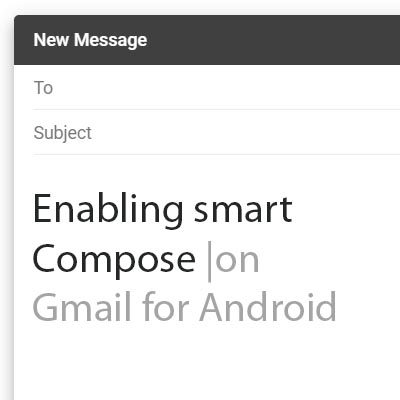
As we have opened our lives to technologies like machine learning and artificial intelligence, it would seem that the beneficial predictions made in science fiction are more likely to become fact. Many of these technologies have actually manifested in some of the smallest, but most useful, ways. For this week’s tip, we’ll learn how to leverage Gmail’s predictive Smart Compose feature on Android.

Those familiar with the online version of Gmail will find all of this quite familiar, as Smart Compose has been predicting their next words for some time now. It will seem newer to those more familiar with the Gmail application in macOS and Windows, as it hasn’t been available there until now.

Using Smart Compose on Android Devices

The first thing you’ll have to have in order to use Smart Compose is an active Google account, with the latest version of the Gmail application installed on your chosen device. As you type, Smart Compose will present its predictive text suggestions that a user can either accept, or just keep typing to ignore. While this form of machine learning is pretty basic, it does demonstrate how a device can “learn” how a user is most likely to use it – in this case, what word is likely to come next in the user’s sentence.

Turning Smart Compose Off (and On Again)

Of course, some users may find these suggestions inconvenient or distracting. That’s totally fair, and means that these users should deactivate the Smart Compose feature. Access the Gmail app’s menu by pressing the hamburger icon at the top left. You should see your Settings from there. You will be asked to choose from the accounts that have access to your device. Once you’ve selected the appropriate account, look under General settings to find Smart Compose. Use the toggle switch to activate it or deactivate it as you please.

While Smart Compose may not be quite as impressive as the artificial intelligence that appears in feature films, it has one major advantage over them: it can actually be used to benefit your business. For other ways that you can give your business operations a boost through technology solutions and tips, subscribe to our blog! You can also reach out to us directly by calling 810.230.9455.
youtube_400.jpg

How to Use YouTube’s Full Capabilities for Your Business

youtube_400.jpg

We all know how to use YouTube… find video, click video, watch video. Simple, right?

Sure – if you want to limit how you can leverage it to your business’ advantage. Here, we’ve assembled a few features that you can use to make YouTube a better resource for your business.

First Up: YouTube’s Keyboard Shortcuts

Whether you’re using YouTube as a research tool or presenting your findings in a meeting, effectively using its built-in shortcuts can make your use of the website much more productive (and, let’s face it, more impressive).

If you’re doing research, jumping back to the beginning of a video will be super handy – and is possible, by pressing the 0 (zero) key. You can also use your arrow keys to fast forward or rewind the video in five-second increments (or ten-second increments, if you hold the Ctrl key at the same time).

If you’re using YouTube as a part of a presentation, you can quickly pause and resume the video by pressing either the spacebar, or the K key. If your audience can’t quite hear what you’re presenting, you can adjust the volume using the up and down arrow keys. The M key will mute the video, and unmute it when you’re ready to hear the video again.

Starting From a Specific Point in the Video

Speaking of using YouTube as a part of your presentation, you may not always want a video to start from the very beginning. YouTube gives you a few options to do so – the easiest being grabbing the altered link to your desired time directly from YouTube.

Let’s look at this video about phishing:

https://www.youtube.com/watch?v=jfnA7UmlZkE

There’s a lot of information in this video. What if you want to focus on one specific aspect, like how phishing can be spotted? This video doesn’t dive into this aspect until just about the one-minute mark. YouTube offers a function that eliminates the need of fast-forwarding to this point. Under the Share option, the menu that appears offers a Start at option. You can select the precise time that you want your video to start. The link that appears will begin your video at the moment you have selected (unless a pesky ad gets in the way):

https://youtu.be/jfnA7UmlZkE?t=63

Search Filters to Improve Your Results

If you’re having trouble finding the right content on YouTube, there are filters that you can whittle down your results by – making it more likely that you will find more videos that fit what you are looking for. You can seek out videos that were uploaded during a specific time frame, that fall within a certain duration, and seek out specific channels, playlists, and other media types – among other filters.

YouTube can be one of the greatest resources available today… as long as you can find and share the information you need. For more ways that technology can improve your business and its processes, subscribe to our blog!

170432530_4_questions_400.jpg

Tip of the Week: 4 Tech Questions, Answered

170432530_4_questions_400.jpg

Have you ever thought about why we use certain techniques to get the most out of our technology? Believe it or not, there is often a rhyme and a reason for why certain tactics are most useful for business technology solutions. We’ll try to get to the bottom of some of the strangest questions you might have about how to use your business technology.

What Does Restarting the Computer Do?
You might think of restarting the computer as something that cuts down on productivity, but this is far from the truth. While it stops you from working in the interim, it’s beneficial in the long run to routinely restart your computer for periodic updates and general upkeep. Have you ever tried to run a machine all the time without giving it a break every now and then? When you do this, it’s more likely that the device will be run into the ground. Your devices will run much better if you restart them every now and then to ensure that they aren’t being overworked.

What Use Is There for Your Task Manager?
You can imagine the look on someone’s face when their computer freezes up and it can’t run properly. Well, once upon a time, someone had the brilliant idea to include a task manager in a computer’ operating system to ensure that you can identify the problematic application (if there is one) and end its tasks without having to restart the computer. Overall, it’s a way to see how your computer’s resources are being allocated, as well as how to end troublesome tasks without restarting the computer.

Why Must Passwords Be Changed?
While some might argue that passwords should only be reset when they are discovered, this in-turn highlights why passwords should be reset frequently. Sometimes passwords will be stolen without the user knowing about it until they are being used against them, but other times, they will be stolen and sold on the black market to the highest bidder. It’s up to the user to make sure any passwords potentially stolen are changed before they can be used against your organization. The best way to protect against this from happening is to assume they will be stolen and change them periodically.

How Do Drivers Affect Your Work?
Drivers can be considered pieces of software that make your device compatible with a variety of external devices. You might have noticed that drivers must be installed on your device in order to use that USB mouse or wireless keyboard. These drivers must be kept up to date so that compatibility with devices doesn’t interfere with your work, and that security vulnerabilities are not presented to nefarious folks who want access to your systems and data.

Do you have any tips that you’d like to share with us? Let us know in the comments, and be sure to subscribe to our blog.

cloud_solutions_business_400.jpg

How to Get the Right Cloud Solution for Your Business

cloud_solutions_business_400.jpg

As technology has become a greater part of today’s working environment, the need for a business to have somewhere to procure the requisite devices from has increased. This is why many businesses serve as vendors, the go-between for the producers of these devices and the businesses looking to purchase them. For obvious reasons, these vendors are essential to the success of many businesses.

There are a few kinds of vendors, offering various things to businesses like assorted supplies, equipment, and services. One kind of vendor that has grown increasingly crucial in particular, is that which delivers cloud services to businesses. Due to the expansion of the cloud’s utility in all kinds of business purposes, the choice of a vendor has also expanded in importance.

How to Select the Right Vendor, for Cloud Services and Otherwise
This is going to require some preemptive research and consideration of your own goals. Once you’ve determined your priorities in both the short and long-term, you and your IT resources should examine your available options to see which vendor is most compatible – and that’s in more ways than one.

Not only should your vendor offer what you need at a reasonable rate, there should be some consistency in the goals that your organization and theirs have. You also need to be able to trust your vendor to attend to the services agreed upon, whether that’s a managed agreement or a simple equipment procurement.

How Cloud Services are Different
However, your vendors for your cloud services should be held to a somewhat higher standard – after all, your data is going to be at stake. Therefore, it is important that they be graded differently than your other vendors would be.

Before committing to a cloud service provider; or a cloud strategy in earnest, there are two considerations that must be examined. First, what data is your vendor going to be able to access, and second, what applications can your vendor access as well?

After this initial consideration, you need to also take other factors into account, like how business-critical a said process is, how compliant they are to certain policies, and how much risk is involved in a given action. From there, you can establish if a particular cloud vendor is a good fit or not.

At NuTech Services, we can technically be considered a vendor ourselves, as we provide our managed services to other businesses. As such, we’d like you to consider us a candidate for your IT needs. Give us a call at 810.230.9455 for more information.

computer_novice_tips_400.jpg

Tip of the Week: 4 Really Simple Tips for the Computer Novice

computer_novice_tips_400.jpg

If you work with a computer, you know that if you can find shortcuts, you use them. Not only do they help you be more productive by making your tasks easier to complete, they can actually help you be MORE effective at completing those tasks. Today, we have four simple tips that can help you build better computer skills.

Tip #1: No Fear
Sometimes technology can be a tad bit intimidating, especially when people are expecting you to quickly grasp a concept with little-to-no experience. The best thing you can do is not be afraid of screwing up. After all, there aren’t many actions you can take with a computer that will break the machine, the applications you are using, or the file you are working on. If you don’t have much experience with the computer and you want to learn anything from this blog today, learn that Ctrl+Z will undo. Having a good understanding that Ctrl+Z will undo your last action in almost every application you are going to use should give you the confidence you need to stop worrying about possible failure.

Tip #2: Liberally Use Search Engines
For the computer novice, it can sometimes be intimidating to try to find applications and files within an operating system. No matter what problems you come across, keep in mind that the Internet is the world’s greatest troubleshooting guide, and you only need to know how to open your browser to get at it (on modern machines, you may not need even that). Once you have your browser open, simply type your search query in the address bar. It will return results. You may have to dig through the results, or alter your search perimeters slightly, but you will be able to find the answers to the problems you are having with the help of a search engine.

Tip #3: Learn Keyboard Shortcuts
This is typically for speed. If you can quickly learn a few basic shortcuts, you will enhance your ability to control your computer tenfold. Here are a few suggestions to get you started:

  • Ctrl+A – Select all
  • Ctrl+C – Copy selected content
  • Ctrl+X – Cut selected content`
  • Ctrl+Z – Undo (Seriously, this one is crucial.)
  • Ctrl+Y – Redo

There are many more depending on the application you are working in. Most applications will provide their shortcuts under their Help menu. Learning these will quickly make you a much more proficient user.

Tip #4: Find Your Comfort Zone
When Michael Jordan first picked up a basketball, he wasn’t a natural, so how can anyone expect to use something as complex as a computer proficiently right off the bat? If you are a new user, or just someone that isn’t proficient with a computer yet, stick to what you know. If you have a series of applications you feel some level of skillfulness with, stick to them. While our first tip suggests that you shouldn’t have fear, that mainly pertains to navigating your way around a computer, not the frustration a user can build when they continuously make mistakes. If you want to enjoy your time on the computer, stick to the applications you know, and you will have a good time.

We want everyone to remember that there was a time when we were all new to the computer; and, since computer skills are now an expectation of almost any career path (not to mention a major form of communication), learning your way around a computer will improve your standard of living. Do you have any other tips you could suggest to new users to keep them engaged and improving? Leave them in the comments section below.

totw_replicate_relocate_400.jpg

Tip of the Week: How to Replicate and Relocate Text Easily

totw_replicate_relocate_400.jpg

Sometimes, things are written in the wrong place. Fortunately, there are means of moving them if they happened to be written using a computer. These processes are relatively very simple and are so commonly used that the shortcuts are right next to each other on the keyboard. For today’s tip, we’ll review how you can cut, copy, and paste content in effectively any program you use.

Once you have your content selected, whether it’s text or an image, all you have to do is press two keys.

To cut a word or phrase from one place in your content, press Ctrl + X. To copy this content instead, keeping the original and duplicating it elsewhere, press Ctrl + C. Pasting your content is just as simple – with the place you want the content added selected, press Ctrl + V. This will insert your content where you want.

If you happen to be copy-pasting from a website to another document, it may not be a bad idea to paste it without bringing any formatting from the website over. Otherwise, it is apt to look funny on your documents. Pasting without formatting is almost as simple as regular pasting, you just add another keystroke in the middle: Ctrl + Shift + V.

Of course, any of the tasks can be accomplished with the mouse alone. Right clicking on a word, an image, or a group of selected text will bring up a menu that includes all of the above options. However, your cursor is generally more accurate than the mouse, so you may have to undo your efforts (Ctrl + Z) a few times before it’s right.

Real World Example:
Let’s say you want to send a webpage link to someone in an email or instant message. In your web browser, click the address bar (that’s the part with the ‘http://… “). That will highlight the URL. Hold down Ctrl and press C. Then go into your email or instant messenger, click where you want to paste the URL, and hold down Ctrl and press V.

Whichever you use, it’s bound to be more time-efficient than rewriting anything that needs to go in a different spot. Make sure you subscribe to our blog, so you can be alerted whenever we upload more content!

totw_pro_plan_400.jpg

Tip of the Week: Three Pro Business Tips

totw_pro_plan_400.jpg

While running a business can be quite rewarding on a professional level, it can be extremely challenging, with countless obstacles to overcome–particularly in regard to technology and its management. Thankfully, there are ways your business can minimize the pain of managing technology. Here are just a few of them.

Be Prepared to Lose Power
Electricity is perhaps the most important part of using technology in the workplace, as without it, the devices that empower your business’ operations just won’t function. In some cases, you might suddenly lose power, leading to data loss and other disaster scenarios that could strike your business down if you’re not prepared for them. With progress grinding to a halt, downtime will ensue, creating a considerable loss for your business.

Even if you’re not losing power, an excessive amount of it can create a surge, damaging the infrastructure itself and harming the individual components that make it up. It’s ultimately in your best interest to take measures against these events, as you made an investment that needs a substantial return. Surge protectors can be helpful to prevent excessive power from crippling these important machines, but in some cases, you’ll want a more powerful solution. An uninterruptible power supply, or UPS device, can help your servers, workstations, and other important technology shut down properly in the event of a power outage or surge, giving you the ability to minimize damage done.

Maintain a Steady Internet Connection
The Internet is an invaluable tool that can help your business succeed, and the Internet plays a larger role in its functionality than it ever has before. A lack of Internet ultimately becomes downtime for many organizations, as they depend on the Internet for various services and communications. More often than not, there’s nothing you can do about a lack of Internet if it comes from your service provider. To keep this kind of downtime from sinking operations, many businesses have implemented backup Internet connections, just in case they ever have to use it. This comes with a downside–you’ll have to maintain that connection–but it will likely be worth the investment if you ever need it.

Place Boundaries on Your Staff
Even the best employees are known to make mistakes from time-to-time. While you can trust them for the most part, nobody is perfect, nor should you expect them to be. Some might even try to implement their own solutions with the intention of making their jobs easier and more efficient. This is called shadow IT, and it can be dangerous. You have no way of knowing whether it’s putting your business at risk. You can implement measures to ensure that your employees aren’t downloading unauthorized applications through the use of administrator and user privileges. If you limit what your users can do with their machines, then you have less to worry about.

NuTech Services can help your business ensure managing IT doesn’t become a hassle. To learn more, reach out to us at 810.230.9455.

evernote_tips_400.jpg

Tip of the Week: Using Templates in Evernote

evernote_tips_400.jpg

The note-taking application Evernote is a favorite of many users, as it allows them to keep extensive notes in an organized fashion. Its true utility goes beyond that of a digital scratch pad, however, as it has additional features that offer much more. For this week’s tip, we’ll review one particularly useful feature: templates.

What Are Templates?
Evernote’s templates are handy, pre-built structures for notes that provide users with a simpler means of organizing specific types of information. Instead of taking time struggling with your formatting each time you start a new note, you can apply one of the templates that Evernote offers on their website. Those with a subscription to Evernote Plus, Premium, or Business can even use formatting they’ve created in past notes to generate their own templates for repeated use.

Applying Templates in Evernote
Once you’ve acquired a few templates, either from the Evernote website’s collection or from a past note, applying one of your choosing is relatively simple.

  • In Evernote, start a new note.
  • In the body of the note, click Templates to view the ones you have saved.
  • From there, you can search for any templates you have, delete ones you no longer want or need, edit their names, and of course, apply them to notes.
  • If you want to edit a template, follow the same process, and once you’ve made the changes that you want, save it as a new template. Note: only those with Plus, Premium, or Business accounts are able to do this.
  • Plus, Premium, and Business users are also able to create their own templates this way.

So, what do you think? Is this a welcome change to Evernote? What other improvements would you like to see them make down the line? Let us know in the comments!

tt_breadcrumb_400.jpg

Know Your Tech: Breadcrumbs

tt_breadcrumb_400.jpg

A trail of breadcrumbs can be a useful thing, whether you’re using it like Hansel and Gretel to find their way back home, or you’re using it in computing to find your way back to a page you were previously on. Today’s tech term is dedicated to the latter.

What is Breadcrumb Navigation?
As per the aforementioned fairy tale, breadcrumb navigation consists of a path leading home. In this case, home is the homepage. With breadcrumb navigation, you can more easily keep track of how you got to the current web page you’re on, as well as the path back to the home page. This path can typically be viewed at the top of the page. Each step includes a link that navigates back to a specific page.

Let’s say that you’re looking at a service page on a website. If the path you took leads back to the home page, you’ll see all of the pages in between in the breadcrumbs menu. For the sake of this example, let’s say the pages in between are the second menu item and the fifth menu item. It would look something like this:

Home > [Menu 2] > [Menu Item 5]

Since these breadcrumbs are links, you can click on any one of them to be brought back to that page. This lets you continue browsing with minimal chance of getting lost on the site trying to backtrack.

More Than Just Websites
You might notice that this navigation style is similar to the ones used in toolbars in file folders or files saved on your desktop. The reason is the same–it makes finding certain files easier at a later date. The location can also be shared with others who need to know where it is.

Breadcrumbs are typically meant for helping users with browsing and organization. Are there any other features out there you can think of that do the same thing? Let us know in the comments.

best_way_to_backup_400.jpg

The Best Way to Approach Data Backup

best_way_to_backup_400.jpg

All businesses hope that they’ll never have to use their data backup and disaster recovery plan, but the point stands that each business should have one, just in case of a worst-case scenario. For a small business with a limited budget, the prospect of investing in a solution they might never need is daunting. To help you get started, we’ve put together a couple of basic backup practices that you should keep in mind for your business.

Back Up As Much Data as Possible
If you’re wondering what data your organization should prioritize, the correct answer is all of it. Data is invaluable in the business world, and even if you think you can make do without some of it, chances are that you can’t guarantee it won’t be useful somewhere down the road. You should never accept data loss of any kind. Tape backup systems tend to take complete backups, but they often can only be performed once a day, making it difficult to take and deploy them adequately without running the risk of either operational inefficiency or losing at least some data from the past 24 hours. We recommend a cloud-hosted backup system that takes snapshots of data that has been changed recently, guaranteeing that all files are kept as up-to-date as possible.

Take Backups as Frequently as Possible
In the event your organization suffers from a disaster, you want to make sure that your backups are as recent as possible. This is to make sure that you lose as little progress as possible when disasters do happen. Imagine finding out that the only data backup you’ve taken was last month. This is why we recommend that your organization take backups as often as every fifteen minutes, guaranteeing that you’ll lose minimal data.

Restore as Quickly as Possible
Let’s imagine that your organization is struck by a disaster. To get back in the game following such an incident, you have to restore your data. However, if you don’t have an infrastructure or device put in place to get this happening as soon as possible, you start to suffer from downtime. This is any time that your organization isn’t functioning as intended, so it should include situations where your technology is failing, your employees can’t work, and your organization can’t take care of customers, among anything else that your business is responsible for. It quickly becomes clear that one of the biggest causes for businesses failing following a disaster is the crippling costs of downtime.

Notice a trend here? Time is of the essence when disaster strikes your organization, and the faster you can get back in action following a disaster, the less money you’ll waste on downtime. The traditional data backup solution isn’t as helpful in this regard as a hosted BDR solution from NuTech Services. Our BDR device can rapidly restore data directly to itself so that your organization can keep chugging along in the face of adversity.

phone_new_data_apps_400.jpg

Tip of the Week: How to Transfer Apps to a New Phone

phone_new_data_apps_400.jpg

There is little that is more satisfying than obtaining a new phone. However, this sense of satisfaction is often undermined by the need to get your applications and data to ensure that your new device has everything you normally use installed. For this week’s tip, we’ll go over a method of making this process easier on an Android phone.

The first step to ensuring that your Android’s data can be retrieved is to ensure that it is properly backed up and able to be retrieved.

To check, you will need to access Settings, before opening Backup & reset. You will then have to toggle on Back up my data. You’ll then return to previous menu and select Backup & reset. Check that your Android account is the correct one in Backup account. You will then toggle automatic restore to On to be able to restore settings and data associated with the Android account in question.

Now that you’ve enabled Android’s backup service, your personal settings and application data will be saved to Google Drive. Now that the preliminary steps are handled, it’s time to restore your applications and settings to your new phone.

Restoration
Restoring your applications and data is pretty straightforward if you are utilizing the Lollipop-version of the Android OS or above. This setting is available to phones as they’re booting up for the first time, or just after they have been factory reset.

  1. Select the arrow at the welcome screen to start setting up your phone.
  2. Select System language and log into your Wi-Fi network.
  3. Select Accept and continue.
  4. You can then copy your Google accounts, apps, and data from another device. If you choose not to do that, you can then forge ahead by logging in to your Google account.
  5. There will be a privacy statement, press Accept.
  6. Now go to the Google services page. Here you can select to enable the backup service for your account.
  7. Choose all your preferences and select Next.
  8. If you want to add an email account, you can do so in the Add another email section. If you don’t need to do that, just select Not now, then click Next.
  9. You will then have to restore your apps from the “Which device?” menu. You will see all the Android devices that you’ve used. Select the device to see which apps will be available when you restore. If you don’t want everything restored, you can choose the arrow next to the Restore option and select what you’d like to restore and what you’d like to leave off your new device.
  10. Choose which device’s configuration you want to restore from, hit Restore.

After your apps are restored, be sure to enable security for your phone; and, if you so choose, get Google Now for your device.

The Android smartphone is one of today’s most important productivity tools. For more great information about mobile usability and security, give us a call today at 810.230.9455.

using_smartphone_tips_400.jpg

Tip of the Week: Using Your Smartphone More Effectively in Five Ways

using_smartphone_tips_400.jpg

It’s getting to the point where most people have a smartphone, even if they shouldn’t necessarily have one. If you go all-in on a device like this to boost your productivity and efficiency, then you know how difficult it can be at times. We’re here to provide you with some tips to help you better take advantage of your smart device.

Use Your Mobile Wireless Hotspot
Often times you’ll find yourself limited by not having a wireless connection for devices like your laptop or tablet. In instances like this, you can turn your smartphone into a mobile wireless hotspot to “piggyback” off of your cellular data plan, providing Internet access to other devices that may need it.

A Bring Your Own Device strategy can help your organization supply employees with a stipend to cover any costs of using the device as a mobile hotspot. On the other hand, you can simply provide them with company devices that have enough data to fulfill their needs.

Sort Your Home Screen
You don’t have to suffer from a cluttered home screen on your device. In fact, depending on your personal preferences, you can either sort your apps into folders, or distribute them across various screens so that you know where to locate each of them. You don’t want to lose track of your applications when you need them most.

Customize Your Email and Browser Options
If you’re using an iPhone or Android device, chances are that your device will default to a specific web browser or email management application. You don’t necessarily have to use these, though. As long as you can find an app for your preferred email application, or whichever application your organization uses to communicate, you can install it and achieve a comparable level of functionality regardless of your choice.

Of course, you’ll want to work with your IT department to ensure that you’re not downloading any malware-laden versions of applications–particularly email and web browsers, which you will be using often.

Use Your Shortcuts
Your device has a plethora of shortcuts available, so do your best to work with them whenever you can. The more you get used to these shortcuts, you’ll find yourself being more productive. Consider how much time you waste trying to figure out just what you’re doing with your device, and you’ll see the importance of understanding how these shortcuts work.

Of course, depending on the model of your phone, you’ll have different shortcuts at your disposal. This is because the software installed on them is likely to be different, so just play around a little bit to find the best shortcuts available for your device.

Research Insurance Options
What would you do if your mobile device fell out of your pocket or bag and smashed into a thousand pieces on the pavement? What about if you lost it while you were out and about? Whatever ill fortune may present itself, you’ll want to look into insurance to make sure that you’re covered in the event of a disastrous scenario.

What are your best smartphone tips? Do you have any that you think should have been on our list? Let us know in the comments.

android_file_transfer_400.jpg

Tip of the Week: Drag and Drop Between Android and Windows

android_file_transfer_400.jpg

Smartphones have proven to be excellent devices for enhancing an employee’s ability to be productive while mobile. However, this approach often means that company work is now on an employee’s mobile device, instead of on your network. This issue can be easily resolved if the mobile device in question runs the Android OS. We’ll go over how for this week’s tip.

Android-to-PC File Transfers
Due to the fact that an Android device allows you direct access to its file system, it can essentially serve the same purpose as your standard external hard drive. Just as you would plug an external hard drive into a computer to move data, you can most likely use the charging cable for your device to connect it to your workstation.

Once your smartphone is connected and unlocked, you should be able to find a notification informing you that the device is charging. Tapping the notification will bring up a menu of the USB connection capabilities, for which one option is “Transfer files.” With that enabled, open File Explorer on your workstation. Your Android device should be accessible through the File Explorer menu.

Accessing your device this way will allow you to browse through your files and copy them over to your PC.

Safely Leveraging BYOD
Of course, security should always be your first concern when implementing a new process. Even a process as small and simple as transferring files from a mobile device needs to be approached mindfully for the business’ safety. A Bring Your Own Device, or BYOD, strategy may be tempting to implement to help cut the costs of equipping your entire staff with company mobile devices. However, if you elect to enact BYOD practices, you need to be sure that you are properly prepared to deal with any risks associated with them. That’s where we come in.

NuTech Services can help you to establish a BYOD strategy that meets the needs of your business–without exposing it to undue risk. Call 810.230.9455 to get started.

tech_tips_400.jpg

Tip of the Week: 10 Technology Practices To Improve Business As Usual

tech_tips_400.jpg

In a business, some jobs belong to certain people: managers make sure that work is done when it needs to be, human resources make sure the workforce is accounted for, and so on. However, some jobs belong to everyone in the modern workplace who works with technology, For our tip of the week, we’ll go over some of these shared responsibilities.

Use the Network
As an insurance policy for your data, make sure that everything is saved to the network, and not on your local PC. This is simply a function of risk management–the network is backed up, while it’s much less likely that your individual PC is. Therefore, by storing data on the network, it won’t be lost if your workstation breaks down–and if your network is properly backed up, your data will still be safe.

Check Email Cognizantly
It is only too easy to click through email messages without really getting the message, which only helps those who use email as a cyber weapon. The easiest way to avoid falling victim to such attacks is to avoid opening attachments from unfamiliar senders. This is a favorite method of cyber criminals to introduce malware into their victims’ networks, so your best bet is to avoid any unexpected attachments.

Let Data Be
Keep your data safe by keeping it in-house where it is secured and backed up, and not uploading it onto your portable device or media storage. Without the protections put in place by the network, your data is much more vulnerable to peeking eyes or meddlesome actions.

Leverage Cloud Technology
If you must access data from outside the network, use a secure cloud solution to do so. The cloud has much more to protect it than a pocket-sized media device does. Ideally, you would also be accessing the cloud via a company virtual private network, as well.

Use Secure Passwords
As much as you love your dog or can remember your make and model of car, these don’t make secure passwords. It wouldn’t take long for someone who knew a little about you to try those exact variables. Instead, use a unique sequence of letters, numbers, and symbols for each account. If you can’t remember more than one password, try using a password manager. At the very least, use passphrases instead of passwords–instead of using a password like ‘FidoMazzerati,’ make a passphrase like ‘FidoLovesToRideInTheM@zzer@ti.’

Keep Passwords To Yourself
After going through the trouble to create a password that is complex enough to satisfy the previous rule, why share it with someone who could easily take advantage of it, or pass it to someone who will? As an example, take your Social Security Number, or other unique form of identification. You wouldn’t pass that around to people, but it essentially serves the same purpose as a password.

Lock Your Workstation
It doesn’t matter whether the risk is of someone stealing data or of someone messing around with your workstation as a prank–either way, productivity and focus in the office will suffer. One of the easiest means of avoiding this is to develop the habit of locking your workstation whenever you step away.

Take Note Of All Issues
Computer problems are bound to happen at some point. It helps to be prepared to fix them when they do. Whenever you encounter an issue, take notes that describe exactly what you were doing so the IT professional can figure out if there’s an underlying issue, and when possible, include a screenshot of the error.

Let IT Handle It
Your computer and the software it relies on will need to be upgraded and, eventually, replaced. When that time comes, don’t take it upon yourself to make any changes in the attempt to save someone else the trouble. Call IT in to help — it is one of the reasons they’re there.

However, many businesses don’t have the resources to hire the IT staff they need. That’s why managed services are part of our offering here at NuTech Services. We can help you monitor and maintain your IT–we’re just a call to 810.230.9455 away.

tabbed_browsing_400.jpg

Tip of the Week: How to Use Tabs to Their Full Potential

tabbed_browsing_400.jpg

Tabbed browsing–it’s so commonplace that some might not even think about what it was like to use the Internet before tabs became a thing. Believe it or not, even this seemingly simple feature has a lot of depth to it. There are all sorts of tips and tricks that you can use to better use the tabbing features of your favorite web browser.

Open a Link in a New Tab
There are several ways to open up a link in a new tab. The first is to use the middle button of your mouse, which can be found by clicking in the mouse wheel used for scrolling. You can also right-click the link and select Open in a new tab. Furthermore, in Internet Explorer and Firefox, you can simply hold down Ctrl and click the link to open it in a new tab.

Close a Tab
The middle button on your mouse is great for closing out of a tab as well. You can just click the X, too, but what fun is that? After all, shortcuts are placed in order to make your life easier, so why not use them to the best of your ability?

Open a New Tab
There’s a keyboard shortcut to open up a new tab. To do so, just use Ctrl+T.

Reopen a Closed Tab
Let’s say that you accidentally close a tab that you wanted to keep open. You can use the keyboard shortcut Ctrl+Shift+T to reopen a closed tab. If there are multiple tabs that you want to reopen, just repeatedly use the shortcut until you are content.

Switch Between Open Tabs
You can even use your keyboard to jump quickly from one tab to the next. Just hold down Ctrl and press the corresponding number on your keyboard. For example, if you use Ctrl+1, you’ll be directed to the first tab from the left.

BONUS for Edge Users
Do you use Windows 10’s Edge browser? If so, there is a great new tab feature for anyone who tends to have way too many tabs open at any given time (you know who you are). Edge users can make groups of tabs and set them aside for later. Click the icon to the left of your tabs (it looks like a window with a back arrow) and it will move all of your open tabs into the menu on the left. You can click on the far-left icon to view all of your stored tabs.

For more great tips and tricks on how to take full advantage of your business technology, subscribe to our blog.

ghetto_audiobooks_400.jpg

Tip of the Week: 2 Free Tools That Will Read Your Text for You

ghetto_audiobooks_400.jpg

For the busy business owner, audiobooks are a godsend. They’re the perfect way to intake information while performing a must-do task that doesn’t require you to think, like commuting or folding laundry. But what’s an audiobook aficionado to do if they’ve got a book or document that they want to listen to that hasn’t been made into an audiobook?

Well, if you’re able to obtain the digital text of the content, then you can use a few software solutions for reading the text back to you. Of course, the quality won’t be anything like what you’ll get from an official audiobook read by the likes of Morgan I’d-narrate-that Freeman, but it’ll make do for when you’re in a productivity pinch.

SpeakIt!
SpeakIt! is a text reading extension for Chrome that’s fairly easy to use. After downloading it, you will see a speaker icon on the upper-right corner of Chrome. With the webpage loaded that you want read to you, go ahead and highlight the specific sentences and paragraphs that you want played back and then click the SpeakIt! icon, and just like that, you’ll hear the text read back to you.

A few advantages of SpeakIt! are that its playback is smooth, and you can adjust the playback speed. The standard speed is 330 words/minute, but you can increase or decrease that speed by ten. SpeakIt! is also capable of reading back several different languages, and it can even translate text while it reads.

The disadvantage of SpeakIt! is that it doesn’t work well with Chrome extensions that you use for writing and editing text, like Google Drive, Gmail, Adobe Reader, etc. Also, several users have reported that SpeakIt! has a tendency to stop working after a minute or two of use, depending on the nature and complexity of the website you’re on. Reloading the web page will often take care of this issue, but this easy fix doesn’t make the issue any less annoying.

@Voice Aloud Reader
If you’re looking for a text-reading mobile app, then @Voice Aloud Reader is a popular option for Android. It’s available for free on the Google Play Store. Also available in the Play Store, are plugins made to enhance @Voice Aloud Reader, like @Voice PDF Crop Plugin which provides increased functionality for reading PDF files.

@Voice Aloud Reader works by uploading the text to its app, then, with the app open, all you have to do is select play and it will be read back to you. The text displayed in the app will retain the original formatting, and @Voice Aloud Reader will even highlight each sentence that’s being read so that you can easily follow along. You can also skip ahead by scrolling down or by clicking the >> button. You can even adjust the pitch and speed of the voice to suit your listening needs.

The advantage of this mobile app is that it’s compatible with a variety of different text formats, like the articles found on web pages, and files like PDF, DOC, TXT, EPUB, FB2, and more. Plus, whenever you upload the text from the webpage, it will upload only the text from the article itself and not any irrelevant content from other parts of the page.

Overall, it’s a highly-rated app with few complaints. The only downside may be the advertisements, but that’s to be expected with a free app. Keep in mind that, for a small fee, you can upgrade to a pro version without advertisements if you prefer.

There you have it. No more excuses for not getting around to reading that book or report, even if you can’t find an official audiobook!

Do you use any tools to knock out reading while you’re working on something else? If so, share them with us in the comments.

b2ap3_thumbnail_bad_cell_phone_etiquitte_400.jpg

Tip of the Week: 4 Social Taboos Smartphone Users Should Never Break

b2ap3_thumbnail_bad_cell_phone_etiquitte_400.jpgCellphone etiquette goes hand-in-hand with common sense. Here are four cellphone etiquette tips that every device owner should know.

Don’t Use Your Phone During Mealtime
Mealtime is a social time for pretty much every culture around the globe. During this time, it’s expected that you are fully present and engaged in conversation–which is super hard to do if you’re glued to your phone. Even the quick glance at the screen to check notifications can be construed as rude.

Solution: Turn your phone off during mealtime, or at least, keep it off the table.

A restaurant in Iowa, Sneaky’s Chicken, offers a 10 percent discount for diners who don’t bring their treasured phone to their meal. Also, Bucato, in Los Angeles, has a dedicated “cell-phone section.”

Use a Voice Level That’s Appropriate for Your Setting
While it’s okay to use your phone in a room with other people, it’s not okay to talk on your phone using such a high volume that others around you can’t focus or must talk over you. The problem here often comes from phone calls with poor connections, causing the caller to feel the need to talk louder so they can be heard. Then there are those who feel the need to speak in abnormally high volumes when using the phone, no matter the situation or quality of their connection, much to the chagrin of those in the same room. Awareness of the volume of one’s own voice is the best deterrent here, which for some people, is easier said than done.

Solution: If you need to speak at higher-than-normal volume when using the phone, step outside or go to the next room

Hang Up Before Checking Out
While it’s perfectly acceptable to shop and use your phone at the same time, it’s rather rude to continue talking on your phone while a cashier is ringing you out. Even if you don’t plan on having a grand conversation with the person behind the register, talking on the phone still communicates that you essentially don’t think very highly of them and their time. Plus, it just makes things awkward for the poor cashier if they have to interrupt your conversation in order to ask you a question about your purchase.

Solution: In a scenario where you must stay on the phone while the cashier is ringing you out, at the very least, apologize for the inconvenience and be attentive to them just in case they need to ask you a question.

Don’t Leave Long Voicemails
Just because you can explain every detail possible in a voicemail, doesn’t mean that you should. When a voicemail goes beyond the one minute mark with no prospect of coming to an end anytime soon, it can overwhelm a person. This is especially the case if the message goes into great detail, requiring you to scramble to find a pen and paper; then you don’t get to a pen in time and have to listen to the long message all over again. Grrrr.

Solution: If you’ve got a lot to share, make the voicemail primarily about having the person call you back. Otherwise, it’s best to just leave your name, what you’re calling about, your callback number, and nothing more.

Surprisingly, as common sense as these tips are, we see cellphone users break them all the time. When it comes to preventing annoyances such as these, spreading knowledge about proper cell phone usage goes a long way. Therefore, if you know of any offenders of cell phone etiquette, share this article with them–in a subtle way.

What are some of the most annoying cellphone usage habits that you’ve observed (or are guilty of)? Let us know in the comments.

b2ap3_thumbnail_keyboard_cleaning_400.jpg

Tip of the Week: How to Save Your Keyboard After Spilling Your Drink On It

b2ap3_thumbnail_keyboard_cleaning_400.jpgYou know that you shouldn’t keep a beverage near your computer, but how good are you at actually abiding by this best practice? Due to the busyness of our modern lives, it’s likely that most office workers eat more meals at their computer than away from it. Inevitably, this will lead to a drink spilt on your keyboard, which can put you in a rather sticky situation.

When your keyboard takes an unintended plunge, what can you do about it?

First off, don’t just sit there with your keyboard sopping wet and try typing into Google, “How to clean Mountain Dew off my keyboard.” The liquid will only seep further into your keyboard, making it extremely difficult to type. Actually, a sugary substance like Mountain Dew will cause your keys to stick, which means that your Google Search query would actually look something like this:

not good ib1

Don’t lollygag when faced with a liquid-on-your-keyboard crisis or you’ll just make the problem worse. Instead, take immediate action by following these five steps:

Power Off Your Computer and Disconnect the Keyboard
By far, your computer is way more important than your keyboard (and quite possibly your outfit that also took a Mountain Dew bath). Therefore, as soon as you can, be sure to either disconnect your keyboard. Most modern keyboards are USB, so they can be unplugged with the computer on, but other keyboards use round connectors. Unplugging the round connectors while the PC is on could cause damage, so if you aren’t sure just shut the PC down before disconnecting the keyboard. Act quickly, the liquid may seep into the keyboard’s circuits and cause some problems (and not the good kind like we saw from Coca-cola’s spilt-soda-on-computer scenario).

Flip the Keyboard Upside Down and Give it a Good Shaking
When you encounter a spill, your first instinct is to get up and grab a towel. Before you do that, flip your keyboard over and shake it. Basically, when dealing with a spill, you’ve got precious little time to locate a towel while the ill-fated beverage seeps deeper and deeper into your circuits.

Wipe Down Your Keyboard
After gravity has done its job and drained as much liquid as possible, now is the time to use a dry cloth to wipe down your mess. Do what you can to get in between the keys, but don’t do anything drastic like apply too much force or pop off the keys, yet. For now, the goal is clean up, not detailing.

Let it Dry Overnight
Next, find a dry place to let your keyboard sit upside down overnight. When you come back to it the next day, look for any additional moisture that may be left and give it a wiping.

Check for Stickiness
Before plugging in your now-dry keyboard, press on every key to check for stickiness. This will most likely be the case if you split a sugary substance, like Mountain Dew. To clean out the stickiness, you’ll have to remove the keys to really clean underneath. Computer Hope offers some solid advice on how to do this:

Removing a standard keyboard key is simple. Start by pressing down on the key in front of the key you want to remove and insert a flat object such as a car key… or a small flathead screwdriver below the key. Once below the key twist it or push down until the key pops off. If you want to remove more than one key, repeat this process until all keys are removed.

Once you’ve got your keys removed, using a tool like a Q-tip will really help with those small and hard-to-reach places, with both your keyboard and your ear canal.

Lastly, with your keyboard fully cleaned and dry, plug it in and give it a spin. If you were fast-acting enough to catch the mess, then you might have been able to save it. Although, if the spill was too great, then your keyboard might be toast and you’ll have to replace it. You’ll know for sure when you sit down with your cleaned keyboard and try it out.

We hope that you’ve found this week’s tip helpful. For more great technology tips, subscribe to NuTech Services’s blog and check back every week.